Mortgage Interest Calculator Guide: Estimate Interest Cost, Amortization, and Break-Even Tradeoffs
People searching for a mortgage interest calculator usually are not asking a purely academic question. They want to know how much of the payment goes to interest, how much a rate change really costs, whether a shorter term is worth it, and how quickly extra payments save money. current user need is strongly tied to affordability pressure, rate sensitivity, escrow confusion, and comparing principal-and-interest math with the full monthly housing payment.
Model the payment and interest while you read.
Open the Mortgage CalculatorQuick answer: what a mortgage interest calculator should show
A useful mortgage interest calculator should show monthly principal and interest, total interest over the loan, and how the interest share changes over time.
It should also separate principal-and-interest math from property taxes, homeowners insurance, PMI, and HOA dues, because those costs affect the monthly housing bill without changing the loan interest itself.
What people are obviously searching for
The main commercial-intent cluster is direct and close to a lending decision:
- mortgage interest calculator
- home loan interest calculator
- total interest paid on mortgage
- mortgage amortization calculator
- monthly mortgage interest calculator
- 30 year mortgage interest calculator
- 15 year mortgage interest calculator
- extra payment mortgage calculator
- mortgage calculator with taxes and insurance
- how much mortgage interest will I pay
What people are really asking before applying or refinancing
The higher-value long-tail questions are more practical and more urgent:
- How much of my first mortgage payment goes to interest?
- Why does a 30-year mortgage cost so much more in interest?
- How much interest do I save by paying extra each month?
- Is it better to lower the rate or shorten the term?
- How do taxes and insurance change the monthly payment but not the loan interest?
- How do I compare 6.25% versus 6.75% over 30 years?
- When does more of the mortgage payment start going to principal?
- Should I use a mortgage interest calculator or an amortization schedule?
- How much interest will I pay if I put less than 20% down?
- What is the break-even point on refinancing closing costs?
The core idea: interest is based on the remaining balance
The simplest monthly mortgage interest estimate is:
monthly interest = remaining balance x annual interest rate / 12
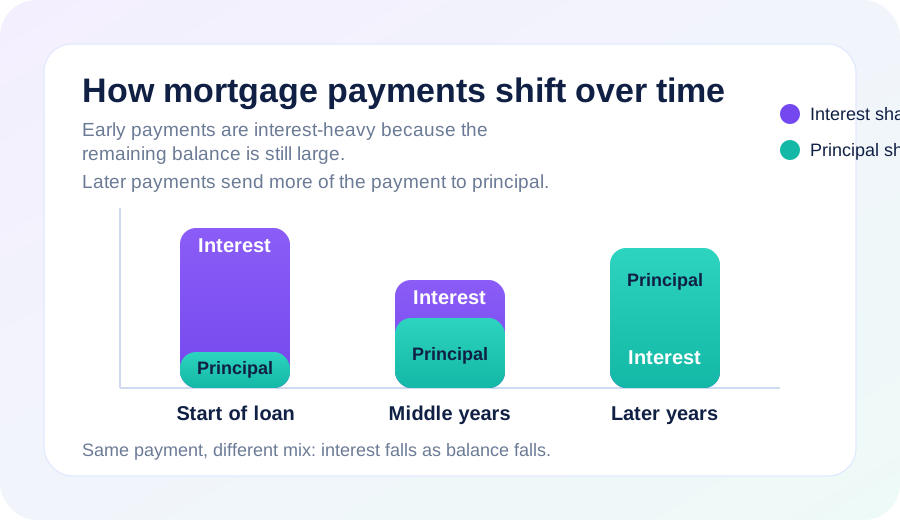
That is only the interest piece for a given month. A fixed mortgage payment also includes principal repayment, and the principal share grows over time as the balance shrinks.
Example: how the first month works
If you borrow $320,000 at 6.5%, the first month's interest is roughly:
$320,000 x 0.065 / 12 = $1,733.33
If the full principal-and-interest payment is about $2,022, then roughly $288.67 goes to principal in month one. That is why borrowers often feel shocked by how slowly the balance moves at the beginning.
Why people compare this carefully
Affordability is rate-sensitive
Small rate changes now translate into large lifetime cost differences, so searchers want calculators that show both the monthly payment and the total interest burden. The question is no longer just "Can I qualify?" It is "What does this rate do to my cash flow and long-term cost?"
Buyers want the real monthly payment, not only principal and interest
Many searchers type "mortgage interest calculator" when they really want to reconcile principal and interest with the full housing payment. Property taxes, homeowners insurance, and sometimes PMI create that gap. Industry guidance often calls the full monthly housing payment PITI for exactly this reason.
Refinance and extra-payment decisions depend on the same math
The same interest calculator helps with purchase decisions, refinance break-even checks, recast comparisons, and extra-payment scenarios. That makes the query commercially valuable and sticky.
How to use a mortgage interest calculator well
1. Start with the real loan amount, not just the home price
Your loan amount is the purchase price minus the down payment, plus any financed upfront costs. If you want the monthly payment to reflect reality, pair this step with the Down Payment Calculator Guide.
2. Compare monthly payment and total interest together
A lower monthly payment can still produce much higher total interest if the term is longer. This is one reason the 15-Year vs 30-Year Mortgage Calculator Guide is a useful companion.
3. Separate principal-and-interest from the full housing bill
Taxes, insurance, HOA dues, and mortgage insurance matter for budgeting, but they are not mortgage interest. Keep them in view so you do not underestimate the actual cash outflow.
4. Test extra payments early
Extra principal often saves the most interest when applied early in the loan. If you are exploring that strategy, continue with the Extra Payment Calculator Guide.
Why 30-year loans cost more interest even when the payment feels safer
A 30-year mortgage spreads repayment across more months, which lowers the required monthly payment. But because the balance stays larger for longer, interest keeps accruing over more of the schedule. That tradeoff is exactly why borrowers compare total interest, not only payment comfort.
Common mortgage interest scenarios
Buying with a smaller down payment
A smaller down payment raises the loan balance and may trigger PMI. That increases the monthly housing cost even though PMI is separate from the actual interest charge.
Comparing two interest rates
Even a half-point difference can materially change lifetime cost on a large mortgage. That is why many searchers compare rate offers before they compare houses.
Refinancing
A lower rate can reduce interest expense, but closing costs and reset loan terms matter. Use the Refinance Calculator Guide when you need a break-even lens rather than rate-only math.
Recasting or paying extra
Some homeowners want a lower payment without replacing the mortgage. In that case the Mortgage Recast Calculator Guide can be more useful than refinance math.
Common mistakes to avoid
Confusing total payment with loan interest
Escrowed taxes and insurance can make the monthly bill much larger than the principal-and-interest amount.
Focusing only on the rate
Term length, down payment, and extra payments can change total interest just as much as the headline rate.
Ignoring amortization timing
The interest share is front-loaded because the balance is largest at the beginning. That is normal amortization behavior, not a billing error.
Using purchase price instead of financed balance
If you model interest on the home price rather than the actual loan amount, the result will be overstated.
Related calculators and guides
- Mortgage Calculator for monthly payment scenarios tied to price, down payment, rate, and term.
- Mortgage Payment Guide for the broader monthly housing-payment breakdown.
- 15-Year vs 30-Year Mortgage Calculator Guide for term tradeoffs.
- Extra Payment Calculator Guide for interest savings from recurring principal prepayments.
- Refinance Calculator Guide for closing-cost and break-even comparisons.
FAQ
How do I calculate the interest part of a mortgage payment?
Multiply the current loan balance by the annual interest rate, then divide by 12. The rest of the fixed monthly payment goes to principal.
Why does a 30-year mortgage cost so much more in interest?
Because the balance remains higher for longer, so interest accrues over many more months even if the payment is easier to manage.
When does more of my payment start going to principal?
It increases gradually over the life of the loan as the balance falls. There is no single sudden switch, but later payments are much more principal-heavy.
Do extra payments reduce interest right away?
Yes. If the extra money is applied to principal, the remaining balance falls sooner and future interest charges are based on a smaller amount.
Are taxes and insurance part of mortgage interest?
No. They can be part of the monthly housing payment, but they are separate from the actual interest charged on the loan balance.