Seller Financing Calculator Guide: Estimate Owner-Financed Home Payment, Balloon Risk, Down Payment, and Refinance Exit
As of July 15, 2026, seller-financing intent is rising because ordinary home financing is still expensive, but many buyers do not want to wait indefinitely for rates to fall. The Associated Press reported on July 10, 2026 that the average 30-year fixed mortgage rate moved back up to 6.49%. SFGate reported on May 5, 2026 that seller financing is gaining traction in California as affordability pressure stays high. WSJ Buy Side reported on July 14, 2026 that national 30-year rates climbed to 6.64%. Searchers are not just asking how owner financing works. They are trying to estimate whether the monthly payment, down payment, and balloon exit actually produce a safer path than a normal mortgage.
Compare the owner-financed payment with a standard-bank fallback first.
Open the Mortgage CalculatorQuick answer: what a seller financing calculator should show
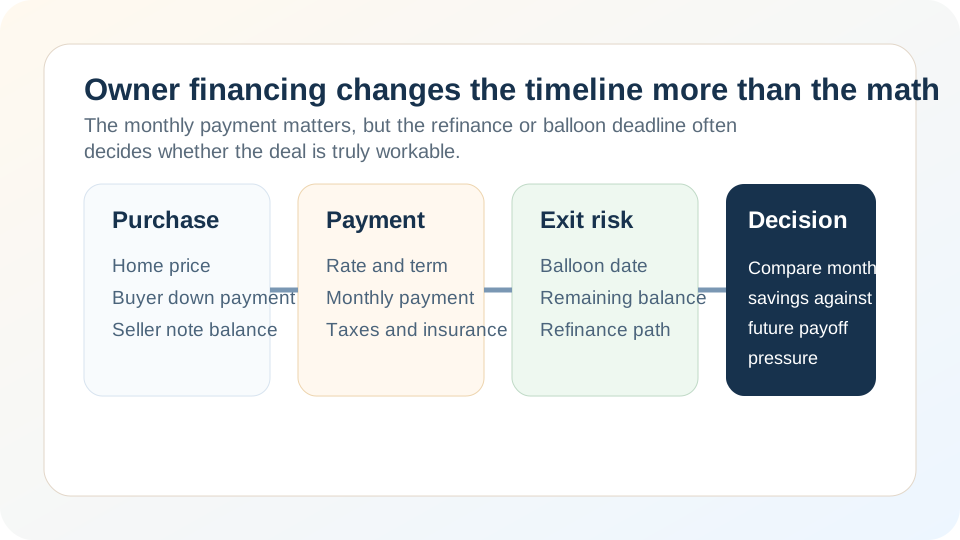
A useful seller financing calculator should show the purchase price, down payment, seller-financed balance, interest rate, amortization term, monthly payment, and the remaining balance that may still be due at a balloon deadline.
Without the balloon or refinance exit, a lower monthly payment can look safer than it really is.
Seller financing can be more than a workaround. In the right deal, it can be a way to create momentum while the market is still awkward. The point is not to chase novelty. It is to use flexibility intelligently, with a clean exit already in view.
What people are obviously searching for
The direct-intent keyword layer is strongly commercial:
- seller financing calculator
- owner financing calculator
- owner financed home calculator
- seller carryback mortgage calculator
- balloon payment seller financing calculator
- contract for deed calculator
- owner carry calculator
- home seller finance calculator
- owner financing mortgage payment calculator
- seller financed house payment calculator
What borrowers and sellers are really trying to understand
The long-tail questions are usually about risk, timing, and exits:
- Is seller financing cheaper than a bank mortgage right now?
- How big should the down payment be in an owner-financed deal?
- What happens if the agreement has a five-year balloon?
- Can I refinance out of seller financing later if rates stay high?
- How do I compare a 6% seller note against a 6.6% bank mortgage?
- Can seller financing help if I am self-employed or have unusual income?
- Do I still pay taxes, insurance, and closing costs normally?
- What legal structure is safer: note and mortgage, land contract, or something else?
- Does a due-on-sale clause create risk if the seller still has a mortgage?
- How do I know if the seller's flexible terms are worth the refinance pressure later?
Why seller-financing intent is active right now
High mortgage rates keep creative financing relevant
AP reported on July 10, 2026 that the average 30-year U.S. mortgage rate rose to 6.49%, and WSJ Buy Side reported on July 14, 2026 that national 30-year rates were around 6.64%. That is enough to keep payment-sensitive buyers searching for alternatives.
Seller financing is reappearing in specific markets
SFGate reported on May 5, 2026 that seller financing was gaining traction in California, with professionals describing rising use among affordability-constrained buyers and motivated sellers.
Creative financing still carries structural risk
Business Insider's housing coverage over the last year has kept warning that unconventional financing can lower the upfront hurdle while pushing risk into a later refinance or payoff event. That is why searchers want calculator help instead of only legal definitions.
Owner financing can solve approval friction but not affordability by itself
Investopedia's owner-financing explainers remain useful because they frame the main tradeoff clearly: flexibility can improve access, but short terms, balloon structures, and weaker consumer protections can still make a deal fragile.
How to estimate seller financing with Calcsy
1. Compare the property against a standard mortgage first
Use Calcsy's Mortgage Calculator with the same purchase price, down payment, and a realistic bank-rate scenario. That gives you the ordinary-market fallback before creative terms change the picture.
2. Run the seller-financed note as a separate payment test
If the deal uses a fixed note with a clear rate and term, the payment math behaves much like an installment loan. Use the Loan Payment Calculator for the seller-financed balance, then compare the output with the bank mortgage baseline.
3. Check whether the monthly savings is real or just delayed pain
Many owner-financed deals use a long amortization to keep the monthly payment modest, but they still require payoff in three, five, or seven years. That means the refinance path matters almost as much as the payment itself. The Refinance Calculator Guide is the right companion page for that check.
4. Add taxes, insurance, and closing friction back in
Seller financing does not erase housing reality. You still need to think through escrow-style costs, insurance, and closing logistics. Use the Closing Costs Calculator Guide and Mortgage Calculator With Taxes and Insurance Guide so the deal is judged on full ownership cost, not only on note payment.
What a strong owner-financing comparison should surface
Bank mortgage
Usually cleaner legally and structurally, but less flexible when your income story or timing does not fit standard underwriting.
Seller financing
Can create a faster path in, but only if the note terms, balloon date, and later refinance path are all realistic from day one.
Pause and prepare
Sometimes the best move is not creative financing. It is using the next 6 to 12 months to improve reserves, documentation, and leverage.
Monthly payment versus refinance deadline
A modest payment is not automatically a win if the remaining balance after five years is still too large to refinance comfortably.
Lower rate versus weaker protections
Sometimes the seller note beats current bank rates. Sometimes the attraction is easier qualification. Either way, the legal structure and servicing standards still matter.
Flexible down payment versus cash-reserve safety
Small down payments can preserve cash, but they can also leave the later refinance harder if equity builds too slowly.
Fast closing versus future financing pressure
Owner financing can move quickly, especially when a conventional lender would slow the deal. But the speed only helps if the exit plan is still credible.
When seller financing may be the stronger path
You are a real buyer but your income story is hard for standard underwriting
Self-employed buyers, commission-heavy earners, or buyers in a temporary documentation gap sometimes use seller financing as a bridge to a later conventional refinance.
The seller is motivated and offering terms that are truly competitive
If the rate, balloon timing, and down payment are all reasonable, seller financing can produce a real advantage rather than a gimmick.
You have a credible refinance or payoff path
The deal becomes stronger when there is a realistic plan for either improving qualification, selling another asset, or refinancing later without relying on perfect market timing.
You found terms that buy time without buying chaos
The best seller-financed deals feel calm on paper. The payment is understandable, the documentation is clean, and the exit plan does not depend on wishful thinking.
When owner financing may be weaker than it first appears
The monthly payment looks good only because the balloon is being ignored
This is the most common math mistake in the entire category.
The seller still has a mortgage with due-on-sale risk
That is not a calculator issue alone, but it is part of the deal-risk stack and should not be treated as legal trivia.
The property is priced high because financing is being offered
Flexible financing can hide an inflated purchase price. The payment may feel manageable while the asset itself is still overpriced.
Mistakes to avoid
Comparing payments without comparing remaining balance at the balloon date
If the payoff number still looks intimidating after several years, the deal may simply be delaying the real affordability test.
Assuming seller financing means no closing or legal costs
The structure may reduce some lender friction, but documentation, title work, recording, and legal review still matter.
Using owner financing to buy more house than you can afford conventionally
That raises the odds that the later refinance becomes the point of failure.
Ignoring the standard-bank benchmark
If you never compare the seller's terms to a normal mortgage, you cannot tell whether the creative structure is actually competitive.
Related calculators and guides
- Mortgage Calculator for the bank-mortgage comparison baseline.
- Loan Payment Calculator for the seller-financed note payment itself.
- Refinance Calculator Guide for the likely exit scenario later.
- Closing Costs Calculator Guide for title, recording, and cash-to-close planning.
- Down Payment Calculator Guide for cash-versus-equity tradeoffs.
FAQ
What should a seller financing calculator show?
It should show the down payment, financed balance, interest rate, monthly payment, amortization, and any balloon amount that may still be due later.
Why is the balloon payment so important?
Because many owner-financed deals keep the monthly payment low with a long amortization but still require a refinance or payoff after only a few years.
Is seller financing always cheaper than a mortgage?
No. Sometimes it is cheaper, sometimes it is easier to qualify for, and sometimes it is simply risk shifted into the future.
Can seller financing help self-employed buyers?
It can, especially when the buyer is temporarily hard to underwrite through a standard lender, but the later exit still needs to be realistic.
What is the biggest calculator mistake here?
Focusing on the monthly payment without comparing the balloon balance, refinance risk, and full ownership costs.