Rent vs Buy Calculator Guide: Compare Monthly Cost, Break-Even, and Flexibility
Rent versus buy planning question in June 2026 is sharper than it used to be. People are not asking whether ownership is good in theory. They are trying to decide whether a specific home purchase beats a specific rent payment after mortgage rates, taxes, insurance, maintenance, down payment, and expected time in the home are all included. With Freddie Mac's 30-year fixed survey still at 6.47% on June 18, 2026, many People are discovering that the old rent-versus-buy shortcuts no longer work cleanly.
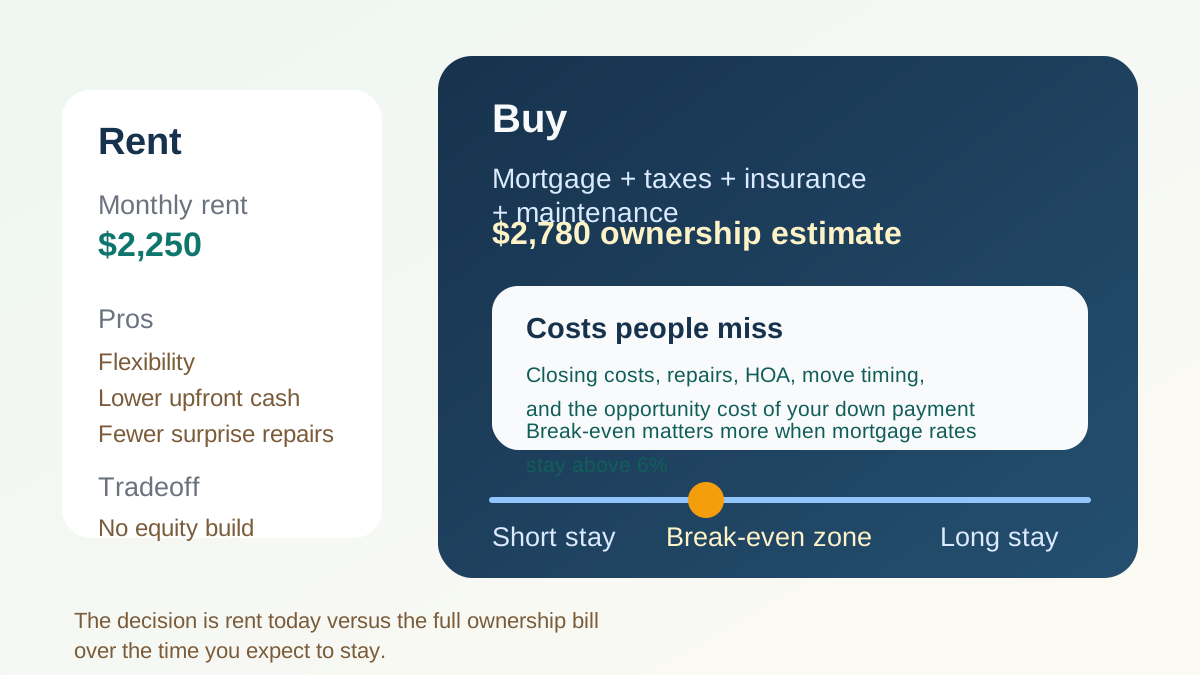
Estimate the ownership side of the comparison while you read.
Open the Mortgage CalculatorQuick answer: what a rent vs buy calculator should do
A useful rent vs buy calculator should compare current rent with the full monthly cost of owning, then test how long you need to stay for buying to make financial sense.
That means principal and interest are only the start. Taxes, insurance, maintenance, closing costs, and the opportunity cost of your down payment all change the answer.
What people are obviously searching for
The head-term cluster is broad but strongly transactional:
- rent vs buy calculator
- rent or buy calculator
- should I rent or buy calculator
- buy vs rent house calculator
- mortgage vs rent calculator
- renting versus buying a house calculator
- break even rent vs buy calculator
- house affordability rent vs buy
- monthly cost rent vs buy calculator
- renting cheaper than buying calculator
What people are really asking before they move
The longer-tail question intent is more personal and more realistic:
- How long do I need to stay before buying beats renting?
- Is renting cheaper than buying right now in my market?
- Should I buy if I only expect to stay five years?
- How much do taxes, insurance, and maintenance change the comparison?
- Is a down payment better used for investing or for buying?
- What if my mortgage payment is close to rent but closing costs are huge?
- Does buying still make sense with rates above 6%?
- Should I rent longer and wait for lower rates?
- Is renting throwing money away if I value flexibility?
- How do I compare an apartment rent payment with a starter-home budget?
Why current rent vs buy intent is different
Mortgage rates still keep ownership costs elevated
Freddie Mac reported on June 18, 2026 that the average 30-year fixed-rate mortgage was 6.47%. At that level, a buyer cannot rely on old rules built around much cheaper financing. Monthly payment sensitivity is simply too high.
Break-even timing has stretched out
Recent housing coverage quoting Zillow's Amanda Pendleton noted that the old two-to-three-year rule has largely broken down, with many buyers now needing closer to seven to nine years on average before buying clearly beats renting. That does not make buying bad. It makes the hold period much more important.
Flexibility has become part of the value equation
Searchers increasingly ask whether renting is still smarter when job mobility, family changes, or market uncertainty make a long ownership timeline hard to defend. That is rational behavior, not indecision.
How to compare renting and buying with Calcsy
1. Estimate the ownership payment honestly
Use Calcsy's Mortgage Calculator to model principal and interest with a realistic home price, down payment, rate, and term. Then add property taxes, homeowners insurance, and a maintenance reserve. If you only compare rent with principal and interest, the result will be too optimistic.
2. Set the comparison against a real rent alternative
Compare the ownership estimate with the actual rent for a place you would genuinely choose. This is where many people distort the math by comparing an apartment with a much nicer or larger home.
3. Think in years, not just months
A monthly ownership cost that is slightly higher than rent can still make sense if you expect to stay long enough. A near-equal payment can still be a bad move if you expect to move soon and absorb closing costs twice.
4. Check whether the purchase fits your broader budget
The rent-vs-buy question is really an affordability question with one extra layer. Use the guardrails in the How Much House Can I Afford Calculator Guide and sanity-check income with the Salary Calculator.
Questions real households ask before choosing
Does buying make sense if the mortgage is only a little higher than rent?
Maybe, but the mortgage is not the whole ownership bill. Taxes, insurance, repairs, and upfront cash can turn a small monthly gap into a much larger real commitment.
How long is long enough to justify closing costs?
There is no fixed answer, but the break-even period matters much more in 2026 than it did when rates were far lower. Short expected stays weaken the case for buying fast.
What if I expect rates to fall and refinance later?
That can help, but it is not guaranteed. A purchase should still be workable before any future refinance rescue. If you want to think through that scenario, the Refinance Calculator Guide is the right follow-up.
Is renting throwing money away?
No. Rent buys housing plus flexibility. It also avoids surprise repairs, selling friction, and some forms of market risk. The right question is whether ownership fits your timeline and finances better.
Common rent vs buy scenarios
First-time buyer with a solid income but limited cash
This search often sounds like a payment question, but it is really a cash-reserve question. A stretched down payment can make ownership fragile even when the monthly mortgage looks manageable.
Renter considering a five-year move horizon
This is where break-even math matters most. A reasonable ownership payment does not automatically beat rent if selling costs arrive before enough equity builds.
Household comparing stability with optionality
Some people are financially able to buy but still rationally prefer renting because job mobility or family uncertainty is high. The calculator should support that decision, not pressure against it.
Mistakes to avoid
Comparing rent with principal and interest only
Ownership costs run wider than the mortgage payment alone.
Ignoring closing costs and move timing
If you may move sooner than expected, transaction costs matter a lot.
Assuming future refinancing will save the deal
Maybe it will, maybe it will not. The purchase should survive current conditions first.
Buying just because rent feels unproductive
The emotional pressure to own can produce a weak financial decision if the budget and timeline are not aligned.
Related calculators and guides
- Mortgage Calculator for the ownership payment side of the comparison.
- How Much House Can I Afford Calculator Guide for payment-first affordability limits.
- Mortgage Payment Guide to understand the payment structure behind the estimate.
- Down Payment Calculator Guide if the real question is how much cash to put down.
- Refinance Calculator Guide if you are buying with the hope of refinancing later.
FAQ
What should a rent vs buy calculator include?
It should include mortgage payment, taxes, insurance, maintenance, upfront cash, expected hold period, and the rent for a comparable place.
How long do I usually need to stay for buying to make sense?
There is no universal number, but many current break-even estimates are much longer than the old two-to-three-year rule.
Is renting throwing money away?
No. Renting purchases flexibility and protection from some ownership costs. It can be the smarter financial choice depending on your timeline and market.
Does buying still make sense with rates above 6%?
Sometimes yes, especially with a long hold period and a sustainable budget. But the margin for sloppy assumptions is much smaller.
What is the biggest mistake in this comparison?
Leaving out taxes, insurance, maintenance, or move timing and then treating the result like a complete answer.