Home Improvement Loan Calculator Guide: Compare Personal Loan, Home Equity, and Monthly Payment
Home improvement loan calculator intent in June 2026 is strongly commercial, but it is not only about finding money for a remodel. People are comparing unsecured personal loans against home equity borrowing, trying to understand whether current rates still make renovations worth financing, and looking for a monthly payment they can survive if the project runs over budget. With personal-loan pricing still elevated and home equity borrowing cheaper but riskier, calculator intent has become comparison-first.
Run the payment math before you compare lenders.
Open the Loan Payment CalculatorQuick answer: what a home improvement loan calculator should do
A useful home improvement loan calculator should estimate monthly payment, total interest, total project borrowing cost, and the tradeoff between fast unsecured financing and lower-rate secured financing.
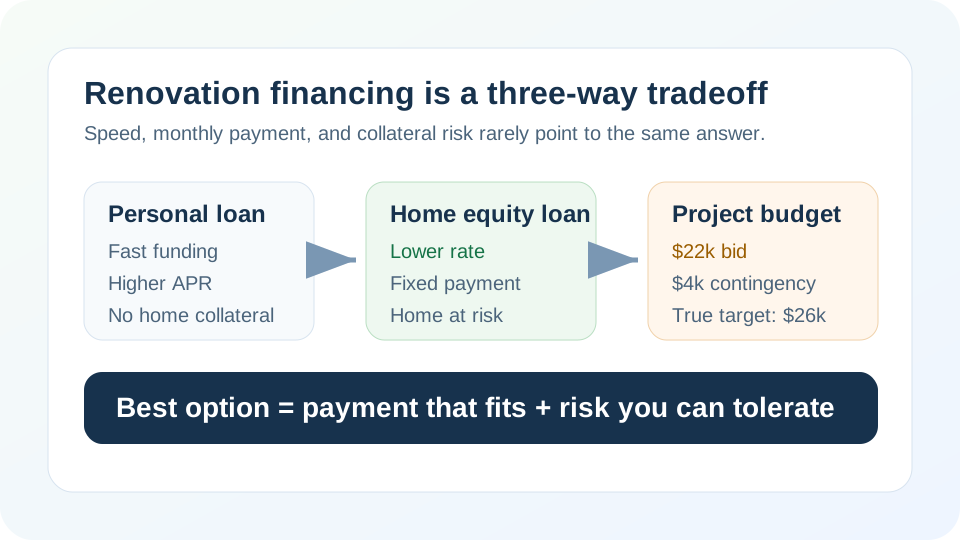
If it only shows one payment, it misses the real decision. Renovation borrowing usually involves a choice between speed, rate, flexibility, and collateral risk.
What people are obviously searching for
The main keyword cluster is direct and high intent:
- home improvement loan calculator
- home renovation loan calculator
- remodel loan calculator
- bathroom remodel financing calculator
- kitchen remodel loan calculator
- home repair loan calculator
- personal loan for home improvement calculator
- home equity loan for renovation calculator
- monthly payment home improvement loan
- best home improvement loan rates
What people are really asking before they borrow
The long-tail questions are more revealing than the head term:
- Should I use a personal loan or my home equity for a remodel?
- How much would a $25,000 home improvement loan cost per month?
- Are home improvement loan rates too high right now to finance a project?
- What credit score do I need for a renovation loan with a decent APR?
- Is it smarter to finance a roof repair or pay cash from savings?
- Can I borrow extra for project overruns without reapplying?
- Is personal loan interest for home improvements tax deductible?
- Should I use a HELOC, home equity loan, or unsecured loan for phased work?
- Will a longer term make the renovation too expensive overall?
- Can a contractor timeline outrun my financing timeline?
Why home improvement loan intent is strong right now
Unsecured renovation money is still available, but expensive
WSJ Buy Side said on June 22, 2026 that the average APR for a personal loan for home improvement was 17.89% as of June 8, 2026, based on Credible partner data. That keeps planning question firmly focused on payment shock, not just approval odds.
Home equity borrowing looks cheaper, but the risk is different
WSJ Buy Side's June 23, 2026 home equity rate roundup said average home equity loan rates were about 8.12% as of June 17, 2026. That rate gap makes secured borrowing attractive, but it also explains why so many searchers compare personal loans, home equity loans, HELOCs, and cash-out refinancing side by side instead of treating them as interchangeable.
Project cost uncertainty changes the best financing choice
Current renovation People are often not funding a neat, one-number expense. They are trying to price a kitchen, roof, HVAC replacement, or multi-step repair where bids move, materials change, and contingency costs matter. That pushes many users toward calculators because they need scenario testing, not one perfect estimate.
How to use Calcsy for renovation borrowing math
1. Start with the true project number, not the optimistic bid
Use the contractor estimate you can defend, then add a contingency buffer before borrowing. Many borrowers underestimate the real amount they will need, which can turn a clean financing plan into a mid-project scramble.
2. Model the unsecured option first
Use Calcsy's Loan Payment Calculator to test the amount, APR, and term of a personal loan. This gives you a clean baseline for speed and convenience. For fee-sensitive comparisons, the APR Calculator Guide helps explain why two similar rates can still produce different total costs.
3. Compare that result with home equity math
If you have equity, test what a fixed second mortgage would look like against the personal-loan payment. Calcsy's Home Equity Loan Calculator Guide is useful here because the lower rate may still come with higher risk and a longer decision cycle.
4. Check the payment against actual income, not wishful budgeting
Renovation financing often looks manageable until you compare it against real take-home pay. Use the Salary Calculator or the context in the Paycheck Calculator Guide to decide whether the new payment fits your month after taxes and essentials.
How borrowers usually choose between financing options
Personal loan for speed and simplicity
This is common when the project is urgent, the borrower has solid credit, and the owner does not want the house tied to the loan. Funding can be faster, but current rates make the payment harder to ignore.
Home equity loan for predictable larger projects
A fixed home equity loan can make sense when the amount is known, the borrower has enough equity, and the payment needs to be lower than an unsecured alternative. The tradeoff is that the home backs the debt.
HELOC for phased or uncertain projects
Many long-tail searches are really asking for draw flexibility. That often signals a HELOC-style need, even when the searcher types home improvement loan calculator. If the scope may expand in stages, a fixed lump-sum loan may be the wrong tool.
Cash-out refinance for owners replacing an existing mortgage anyway
This path usually works best when the homeowner already has a mortgage reason to refinance, not just a project reason. If the idea is simply to trade every old debt for one new larger mortgage, compare it with the caution in the Refinance Calculator Guide.
Mistakes to avoid
Borrowing to the contractor's best-case quote
Renovation budgets move. A calculator should help you test a cushion, not lock you into the most optimistic scenario.
Choosing the lowest monthly payment without checking total cost
A longer term can make the monthly number easier while turning a manageable project into expensive debt.
Ignoring the difference between secured and unsecured debt
A home equity loan may be cheaper, but the downside is much larger if repayment goes badly.
Assuming tax treatment is the same for every option
Personal-loan interest is usually not deductible, while certain home-secured borrowing used to substantially improve the home may be treated differently. That is a tax question, not a calculator shortcut.
Related calculators and guides
- Loan Payment Calculator for the monthly payment, total interest, and total paid on a renovation loan.
- Home Equity Loan Calculator Guide for comparing lower-rate secured borrowing.
- APR Calculator Guide for understanding fees versus headline rate.
- Refinance Calculator Guide if the renovation decision overlaps with replacing a mortgage.
- Paycheck Calculator Guide for checking whether the payment actually fits take-home cash flow.
FAQ
What should a home improvement loan calculator show?
It should show the payment, total interest, total paid, and how the result changes when you compare unsecured and home-secured borrowing.
Is a personal loan or home equity loan better for remodeling?
A personal loan is faster and does not use your home as collateral. A home equity loan may cost less, but the stakes are higher if repayment fails.
Can a lower monthly payment still be a bad renovation loan?
Yes. A lower payment often comes from a longer term, which can make the renovation much more expensive overall.
Is home improvement loan interest tax deductible?
Usually not for a standard personal loan. Some home-secured borrowing used to buy, build, or substantially improve the home may be treated differently, so this needs tax-specific guidance.
When does a HELOC make more sense than a fixed loan?
Usually when the project scope is phased or uncertain and you need flexible access to funds instead of one fixed lump sum.