HELOC vs Home Equity Loan Calculator Guide: Compare Payment, Flexibility, and Rate Risk
HELOC versus home equity loan intent in July 2026 is not a generic education search. It is a borrowing-decision search. Homeowners are trying to keep a low first-mortgage rate, tap equity without refinancing the whole house, and decide whether flexibility is worth variable-rate risk. Current home equity loan rates are still around 8.12% as of July 2, 2026 according to WSJ Buy Side, while Kiplinger reports many HELOC offers remain in the mid-7% range and some now require a large opening draw. That makes the calculator question less about which option sounds cheaper and more about which payment structure fits the actual use case.
Model the fixed-payment scenario while you compare structures.
Open the Loan Payment CalculatorQuick answer: what this comparison calculator should show
A useful HELOC versus home equity loan calculator should show how a fixed lump-sum payment compares with a line-of-credit payment that may start lower but change over time.
It should also make the borrowing purpose explicit, because staged renovation spending, debt consolidation, and one-time expenses do not all point to the same product.
What people are obviously searching for
The head-term intent is direct and commercial:
- HELOC vs home equity loan calculator
- home equity loan vs HELOC payment calculator
- HELOC or home equity loan for renovations
- HELOC vs second mortgage calculator
- HELOC monthly payment vs home equity loan
- fixed rate vs variable rate home equity calculator
- HELOC draw period calculator
- home equity loan payment calculator
- HELOC repayment calculator
- best way to borrow home equity
What people are really asking before borrowing against the house
The long-tail questions reveal the real decision pressure:
- Should I use a HELOC or a home equity loan for a remodel with uncertain final cost?
- Is a fixed payment safer than a lower opening variable payment?
- What happens if prime stays high for years after I open a HELOC?
- Do I need one lump sum now or access to money over time?
- How much can a HELOC payment jump after the draw period ends?
- Is a home equity loan better for debt consolidation than a HELOC?
- Can a lender force a large initial draw on a HELOC?
- Which option is better if I might move within a few years?
- Is it smarter to avoid touching my low first-mortgage rate?
- What can I really afford once this payment is added to my housing costs?
How the two structures differ
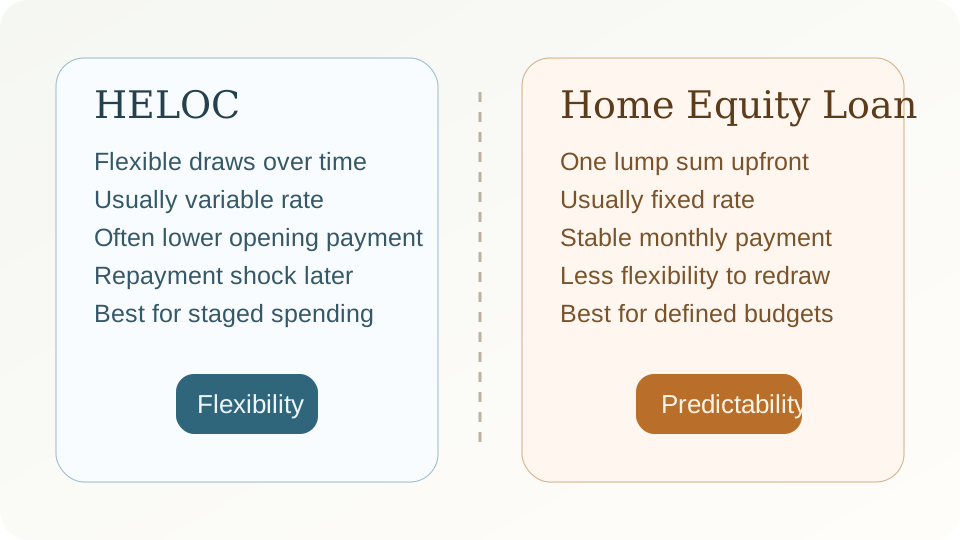
HELOC: flexible but rate-sensitive
A HELOC works like revolving credit backed by the home. That is useful when costs arrive in stages, but many lines have variable rates and can produce a much higher payment later when repayment begins. The HELOC Payment Calculator Guide covers that draw-to-repayment shift in detail.
Home equity loan: simpler but less flexible
A home equity loan typically gives one lump sum with a fixed rate and fixed monthly payment. That makes it easier to budget, especially for a defined renovation budget or planned one-time expense. The Home Equity Loan Calculator Guide is the right companion if predictable repayment is the main concern.
Both put the house on the line
The product structure changes, but the collateral risk does not disappear. Either way, the loan should be judged against the full housing budget rather than as a standalone payment.
How to compare the payment with Calcsy
1. Model the known lump-sum case first
If you know the amount, run it through Calcsy's Loan Payment Calculator using a realistic rate and term. That gives you the cleanest version of the home equity loan path.
2. Separate flexibility from affordability
Many borrowers choose the HELOC because the opening payment looks smaller. That can be reasonable, but only if you also test whether the later repayment phase still works when principal is included and rates are not lower.
3. Match the product to the borrowing purpose
For staged renovation draws, a HELOC often fits the cash-flow pattern better. For debt consolidation or a one-time project with a firm budget, fixed payments can be easier to control. The Home Improvement Loan Calculator Guide is helpful when the purpose is renovation rather than general borrowing.
4. Check the payment against total housing pressure
Compare the added payment against the guardrails in the Mortgage Payment Guide or the affordability context in the Debt-to-Income Ratio Calculator Guide. Equity borrowing should not be evaluated in a vacuum.
When a HELOC usually fits better
Renovations with uncertain timing or scope
If the contractor schedule is phased or the amount is not perfectly known, flexible draw access can be more valuable than a fixed lump sum.
Shorter-term liquidity needs
Some homeowners want access to funds without replacing a strong first mortgage and without borrowing every dollar on day one.
Borrowers comfortable with variable-rate risk
A HELOC works best when the borrower understands that the payment can move and has enough margin to absorb that change.
When a home equity loan usually fits better
Defined project budgets
Known renovation scope, a one-time major expense, or a targeted consolidation plan usually align better with one fixed amount and one fixed payment.
Households that need payment certainty
If the budget is already tight, a fixed payment may be safer than a rate-linked line even when the starting rate looks a little higher.
Borrowers who want fewer moving parts
Fixed-rate installment math is easier to compare, easier to track, and harder to rationalize into overborrowing.
Mistakes to avoid
Choosing based on the lowest opening payment
That often biases the decision toward the HELOC without testing the later payment structure.
Ignoring lender-specific HELOC rules
Some current offers require large initial draws, which reduces flexibility and can make the line costlier than expected.
Using home-secured debt to solve a recurring spending gap
Either product can lower immediate pressure while increasing long-term risk if the underlying budget problem stays in place.
Forgetting the full housing stack
Mortgage, taxes, insurance, HOA, repairs, and the new equity payment all compete for the same monthly cash flow.
Related calculators and guides
- HELOC Payment Calculator Guide for draw-period and repayment-phase math.
- Home Equity Loan Calculator Guide for fixed-payment second-mortgage planning.
- Refinance Calculator Guide if you are also considering replacing the first mortgage.
- Debt-to-Income Ratio Calculator Guide for checking whether the added payment is sustainable.
- Loan Payment Calculator for the fixed-loan comparison case.
FAQ
What is the main difference between a HELOC and a home equity loan?
A HELOC is a revolving line that usually has a variable rate, while a home equity loan is a lump-sum loan that usually has a fixed rate and fixed payment.
When is a HELOC better than a home equity loan?
Usually when spending happens in stages and you need flexible access to funds instead of one fixed lump sum.
When is a home equity loan better than a HELOC?
Usually when the amount is known and you want stable repayment from the start.
Which option is safer if rates stay high?
The fixed-rate home equity loan is usually safer from a payment-volatility standpoint, even if the opening HELOC payment looks lower.
What is the biggest comparison mistake?
Choosing the product that looks cheapest today without matching it to the real borrowing pattern and long-term budget.