Debt-to-Income Ratio Calculator Guide: What Counts, Mortgage Limits, and How to Lower DTI
As of July 1, 2026, debt-to-income ratio calculator intent is highly practical. People are not asking for a textbook definition. They are trying to find out whether a car payment, student loan, or rising HOA dues will knock them out of a mortgage approval range while 30-year fixed rates remain around 6.49%. The real planning question is part math, part diagnosis: what counts, what does not, and which monthly obligation is doing the most damage.
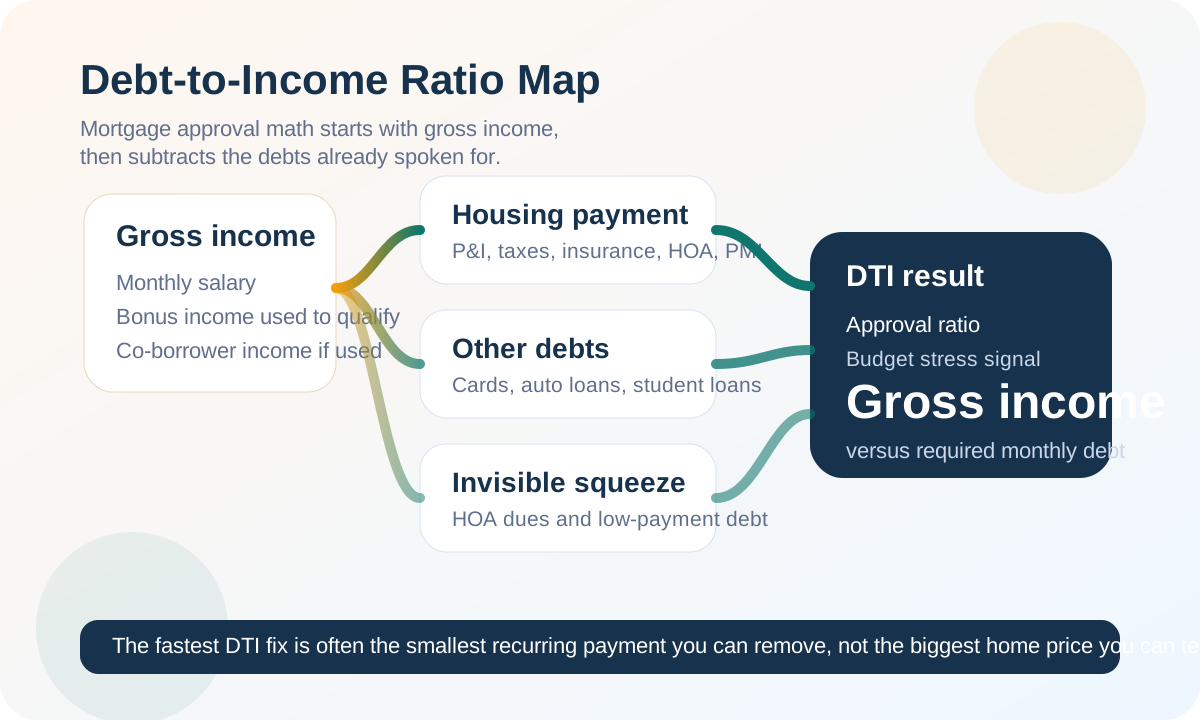
Run the housing payment first, then test the ratio.
Open the Mortgage CalculatorQuick answer: what a debt-to-income ratio calculator should show
A useful debt-to-income ratio calculator should estimate your total required monthly debt payments as a percentage of gross monthly income, including the projected housing payment and the recurring debts lenders are likely to count.
If the calculator skips taxes, insurance, HOA dues, or student-loan treatment, it can understate the ratio enough to create a false sense of affordability.
What people are obviously searching for
The head-term intent is direct and qualification-focused:
- debt-to-income ratio calculator
- dti calculator
- mortgage debt-to-income calculator
- how to calculate debt-to-income ratio
- what is a good debt-to-income ratio
- home loan dti calculator
- front-end and back-end dti calculator
- debt-to-income ratio for mortgage approval
- max dti for conventional loan
- student loan debt-to-income calculator
What people are really asking before they apply
The long-tail questions show the practical friction behind the search:
- Does a car payment lower how much house I can afford?
- Do HOA fees count in debt-to-income ratio?
- What if my student loan payment shows $0 on the credit report?
- Should I pay off a credit card before applying for a mortgage?
- Why is my lender's DTI different from my own math?
- Does gross income or take-home pay go into DTI?
- How much does a personal loan hurt mortgage approval?
- Can I still qualify with DTI above 43%?
- Does child support count in debt-to-income?
- Should I pay down debt or raise my down payment first?
Why DTI intent is strong right now
Mortgage rates are still heavy enough to squeeze ratios
Freddie Mac's Primary Mortgage Market Survey said the average 30-year fixed-rate mortgage was 6.49% as of June 25, 2026, with rates staying relatively stable over the prior six weeks. That keeps the housing-payment side of DTI elevated even when buyers improve their down payment.
HOA dues are showing up in more listings
Axios reported on March 9, 2026 that about 44% of homes listed for sale in 2025 had HOA dues, up from 42% in 2024 and 34% in 2019. Searchers now ask about HOA math more often because it can quietly reduce buying power, especially for condos and newer communities.
Student-loan treatment still confuses borrowers
Fannie Mae's current selling guide is explicit that student loans can still affect qualifying even when the visible payment is unusual. That makes debt-to-income searches more diagnostic than they used to be, especially for first-time buyers carrying student debt.
How debt-to-income ratio works
Gross monthly income is the denominator
DTI uses gross monthly income, not take-home pay. That is why a ratio can look more comfortable on paper than it feels in the household budget.
Required monthly obligations form the numerator
Fannie Mae says total monthly obligations include the qualifying payment for the subject mortgage loan plus other long-term and significant short-term monthly debts. In plain language, DTI is asking how much of your gross income is already committed before ordinary living expenses even start.
There are really two common DTI views
Searchers often mean the back-end ratio, which includes housing plus other recurring debt. But some calculators also show a front-end housing-only ratio because housing cost by itself can still break the budget before the full DTI cap does.
What usually counts in DTI
Housing payment
For a purchase mortgage, think principal, interest, property taxes, insurance, mortgage insurance when relevant, and HOA dues when relevant. The Mortgage Payment Guide and How Much House Can I Afford Calculator Guide are useful because they force those pieces into one payment estimate.
Credit cards and revolving debt
Fannie Mae says revolving accounts are treated as recurring monthly debt obligations. If the credit report does not show a usable minimum payment, the lender may have to use 5% of the outstanding balance or, for DU casefiles, the greater of $10 or 5%.
Car loans, personal loans, and installment debt
These are straightforward because the scheduled monthly payment is visible. If you want to test whether paying one off changes the picture enough to matter, compare the payment inside Calcsy's Loan Payment Calculator first.
Student loans
Fannie Mae says a documented monthly student-loan payment can be used for qualifying. If the report shows $0 or no payment, the lender may use documented income-driven terms, 1% of the outstanding balance, or a fully amortizing payment depending on the scenario. That is one reason mortgage buyers search DTI questions and student-loan questions together.
Typical lender boundaries people search around
Fannie Mae says manually underwritten loans generally have a maximum total DTI ratio of 36%, can go up to 45% with qualifying strengths, and DU casefiles can reach 50%. That does not mean 50% is comfortable. It means approval math and real-life budget comfort are separate questions.
How to estimate your ratio with Calcsy
1. Build the monthly housing payment honestly
Start with the Mortgage Calculator. Include taxes, insurance, and any likely HOA dues instead of using principal and interest alone.
2. Add recurring debts exactly as they exist now
Use the current required payment for car loans, installment loans, cards, and student loans. Do not substitute the payment you wish you had.
3. Compare approval math against comfort math
The How Much House Can I Afford Calculator Guide matters here because a ratio may technically pass while still leaving too little room for maintenance, childcare, or ordinary life.
4. Test the cheapest fix
Sometimes paying off a small auto loan or card minimum moves DTI more than increasing the down payment. The Down Payment Calculator Guide helps compare those tradeoffs.
Common DTI scenarios
Buyer with strong income but too much monthly debt
This searcher usually has enough income to buy, but too many recurring obligations are crowding the ratio.
Buyer with student loans and a clean credit file
The confusion is not credit score. It is how lenders will treat the student-loan payment when the monthly amount looks low, deferred, or inconsistent with the balance.
Condo buyer surprised by HOA fees
planning question here is often triggered after the shopping phase starts. The home price looks manageable until HOA dues become a recurring ratio problem.
Common mistakes to avoid
Using take-home pay instead of gross income
That produces the wrong ratio and mixes lender math with household budgeting math.
Ignoring taxes, insurance, or HOA dues
This is one of the most common reasons online affordability estimates look stronger than lender estimates.
Assuming a $0 student-loan payment means no DTI impact
Depending on documentation and loan type, lenders may still need to qualify the debt using a different payment assumption.
Optimizing only for approval
A ratio can pass and still create a stressful monthly budget. Approval is not the same as resilience.
Related calculators and guides
- Mortgage Calculator for estimating the housing payment that feeds DTI.
- How Much House Can I Afford Calculator Guide for the broader budget view.
- Mortgage Payment Guide for principal, interest, taxes, and insurance math.
- Down Payment Calculator Guide for cash-versus-payment tradeoffs.
- Loan Payment Calculator for testing whether paying off one installment debt improves the ratio enough to matter.
FAQ
What should a debt-to-income ratio calculator include?
Gross monthly income, the projected housing payment, and recurring required monthly debts such as cards, loans, student loans, and HOA dues tied to housing.
What DTI ratio do mortgage lenders usually want?
It depends on loan type and underwriting path, but Fannie Mae says manually underwritten loans generally cap total DTI at 36%, can stretch to 45% with stronger factors, and DU casefiles can go up to 50%.
Do student loans count even if the credit report shows a $0 payment?
Yes, they can. The lender may use documented income-driven payments, a 1% balance proxy, or a fully amortizing payment depending on the file.
Do HOA fees count in DTI?
Yes. HOA dues tied to the subject housing payment can reduce affordability just like taxes or insurance do.
Should I pay down debt or increase my down payment first?
It depends on what is binding. If DTI is the constraint, eliminating a recurring payment can help more than adding cash to the down payment.