HELOC vs Cash-Out Refinance Calculator Guide: Compare Payment, Rate Reset, Fees, and Flexibility
As of July 14, 2026, HELOC versus cash-out refinance intent is highly transactional because homeowners are still caught between two rate worlds. WSJ Buy Side reported average home equity loan rates at 8.08% on July 13, 2026, while its July 13 mortgage-rate coverage put average 30-year fixed rates around 6.58%. That does not automatically make cash-out refinance cheaper. Many owners are still sitting on first mortgages from the low-rate era, so replacing the whole loan can be the expensive move even when the new headline rate looks lower than a second-lien option. Searchers are really asking whether flexibility, payment stability, or preserving the old first mortgage matters most.
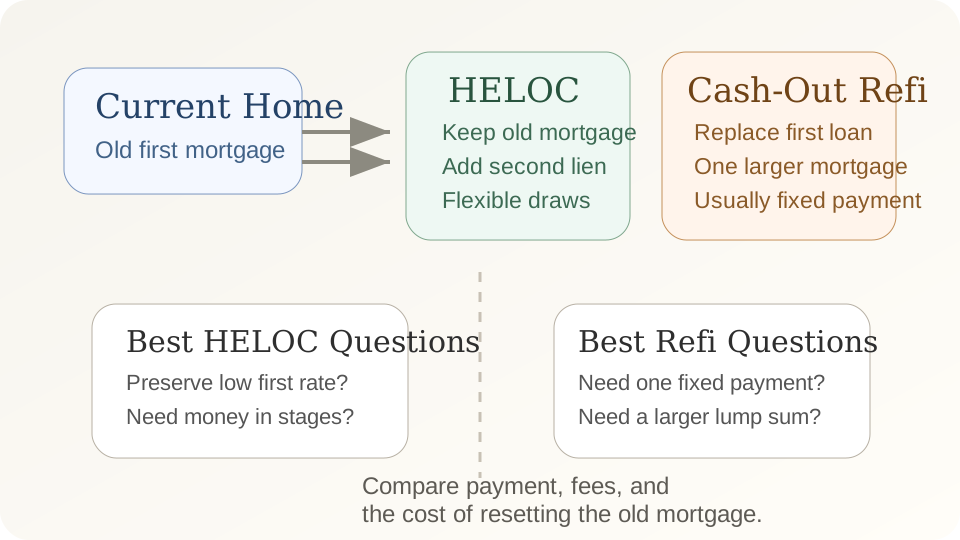
Test the replacement-loan payment before comparing it with a second-lien option.
Open the Mortgage CalculatorQuick answer: what this calculator comparison should show
A useful HELOC versus cash-out refinance calculator should show the old mortgage payment, the new combined payment under each option, the cash available after fees, and whether the borrower is resetting a low first-mortgage rate.
If the comparison only shows one teaser payment, it misses the real question most homeowners are trying to answer in 2026.
What people are obviously searching for
The direct search intent is commercial and comparison-driven:
- HELOC vs cash-out refinance calculator
- cash-out refinance vs HELOC calculator
- HELOC or cash-out refinance for debt consolidation
- HELOC vs refinance payment calculator
- cash-out refinance monthly payment calculator
- HELOC repayment calculator
- should I do a HELOC or cash-out refinance
- cash-out refi vs second mortgage
- best way to tap home equity
- HELOC vs cash-out refinance for renovations
What homeowners are really asking before they borrow
The non-obvious long-tail questions reveal the actual decision pressure:
- Should I replace a 3% mortgage just to pull out $40,000?
- How much does a HELOC payment jump when the draw period ends?
- Is a cash-out refinance safer than a variable-rate HELOC if rates stay high?
- How much cash do I lose to refinance closing costs before I even start the project?
- Is a HELOC better if I only need money in stages?
- What if I need a lower payment now but not another 30-year reset?
- Can a HELOC help me preserve a low first mortgage while still consolidating debt?
- What if I plan to move in three to five years?
- Does cash-out refinance make sense if my current loan balance is already low?
- Which option is less risky if my income is solid now but not guaranteed later?
Why this comparison is active right now
Mortgage rates are still well above many existing first mortgages
WSJ Buy Side's July 13, 2026 rate roundup placed average 30-year fixed mortgage rates at 6.58%, while the Associated Press reported Freddie Mac's weekly average at 6.49% on July 10, 2026. That means many homeowners would be swapping a much cheaper legacy mortgage for a materially costlier new first lien.
Home equity is still tempting borrowers
AP reported in August 2025 that cash-out refinance activity had climbed to about 60% of all refinance loans in the second quarter of 2025, with borrowers pulling roughly $94,000 on average. That tells you the demand is real, but it also shows why borrowers now need sharper comparison math.
Borrowing costs remain high enough that structure matters
Kiplinger wrote in April 2026 that homeowners still held roughly $17 trillion in total home equity, with about $11 trillion considered tappable, even as borrowing rates around 8% kept the decision risky. In other words, access is not the problem. Product fit is.
How to compare HELOC versus cash-out refinance with Calcsy
1. Start with the current mortgage, not the new offer
Write down the current balance, remaining term, monthly payment, and current rate. If you skip this baseline, a new quote can look cleaner than it really is.
2. Model the replacement mortgage as a full refinance
Use Calcsy's Mortgage Calculator for the new loan amount, new rate, and new term. This shows the payment if you replace the whole first mortgage.
3. Model the second-lien case separately
Use the Loan Payment Calculator to estimate a fixed second-lien payment, then compare it against the draw-and-repayment dynamics in the HELOC Payment Calculator Guide. A HELOC can look lighter at the start because it often behaves like interest-only borrowing early on.
4. Add fees and timing back into the decision
Cash-out refinance often carries larger closing costs than a second lien. The Closing Costs Calculator Guide helps frame how much cash actually reaches you after lender, title, and prepaid items are counted.
When a HELOC usually fits better
You want to preserve a low first mortgage
If the current mortgage rate is much lower than market rates, replacing the full loan can be expensive over time even if the new payment looks manageable today.
You need funds in stages, not one lump sum
A HELOC is often the cleaner fit for phased renovation work, uncertain contractor timing, or a smaller liquidity buffer rather than one fixed borrowing event.
You may move before refinance costs fully pay off
Borrowers with a shorter holding period often care more about preserving flexibility and minimizing upfront cost than about building a brand-new 30-year mortgage.
When a cash-out refinance usually fits better
You want one fixed-rate payment
Some borrowers care more about predictability than preserving the old first mortgage. One fixed payment can be easier to budget than a variable-rate line that later converts into principal-and-interest repayment.
You need a larger lump sum
If the project or debt-restructuring need is large, a full refinance can simplify the payment stack and avoid carrying both a first and second lien.
Your current first mortgage is not unusually cheap
If the old mortgage rate is already near current market levels, the penalty for replacement may be small enough that a cash-out refinance deserves a serious look.
Mistakes that distort the comparison
Comparing only the opening payment
This often favors the HELOC because the earliest payment can look smaller, even though the later repayment phase may be much less comfortable.
Ignoring the cost of replacing the old mortgage
This is the main trap in cash-out refinance math. The question is not only how much new cash you get. It is how much value you surrender when you reset the existing first loan.
Using home-secured debt for a recurring cash-flow problem
Either option can temporarily relieve pressure while increasing long-term housing risk if the underlying budget problem never gets fixed.
Forgetting the full monthly housing stack
The right payment check includes taxes, insurance, HOA, maintenance, and the new borrowing cost. The Debt-to-Income Ratio Calculator Guide is useful here because many home-equity decisions are really affordability decisions in disguise.
Related calculators and guides
- Cash-Out Refinance Calculator Guide for the first-lien replacement case.
- HELOC Payment Calculator Guide for draw-period and repayment-shift math.
- HELOC vs Home Equity Loan Calculator Guide for a second-lien-only comparison.
- Refinance Calculator Guide for break-even framing.
- Mortgage Calculator for modeling the full replacement-loan path.
FAQ
What is the main difference between a HELOC and a cash-out refinance?
A HELOC usually leaves the current first mortgage in place and adds a second lien, while a cash-out refinance replaces the existing first mortgage with a larger new one.
When is a HELOC usually better than a cash-out refinance?
Usually when the current first mortgage rate is much lower than today's market and the borrower wants flexible access to a smaller amount of equity.
When is a cash-out refinance usually better than a HELOC?
Usually when the borrower wants one fixed-rate loan, needs a larger lump sum, and is not giving up an unusually favorable first-mortgage rate.
What is the biggest comparison mistake?
Looking only at the opening payment without checking fees, the existing first-mortgage rate, and the later repayment structure.
Can this comparison change if I plan to move soon?
Yes. A shorter expected hold period often makes refinance closing costs and rate-reset tradeoffs more important.
Research references
- WSJ Buy Side: Current Home Equity Loan Rates, published July 13, 2026
- WSJ Buy Side: Mortgage Rates Today, July 13, 2026
- Associated Press: Freddie Mac weekly mortgage-rate update, July 10, 2026
- Kiplinger: What to Know Before Tapping Home Equity, April 2026
- Associated Press: Cash-out refinance activity and equity-withdrawal trends, August 2025