FHA Loan Calculator Guide: Estimate Payment, MIP, Cash to Close, and Buying Power
As of July 6, 2026, FHA loan search intent is being shaped by a simple tension: mortgage rates are still elevated, but many buyers still need a path into the market with less cash upfront. In the first week of July 2026, the average 30-year fixed mortgage rate was still in the mid-6% range, and that keeps first-time buyers looking for calculators that can answer more than the base principal-and-interest payment. They want to know the real monthly number after FHA mortgage insurance, the minimum realistic cash to close, whether 3.5% down is enough, and whether their county's FHA limit changes what price range is even possible.
Run the principal-and-interest estimate while you read.
Open the Mortgage CalculatorQuick answer: what an FHA loan calculator should show
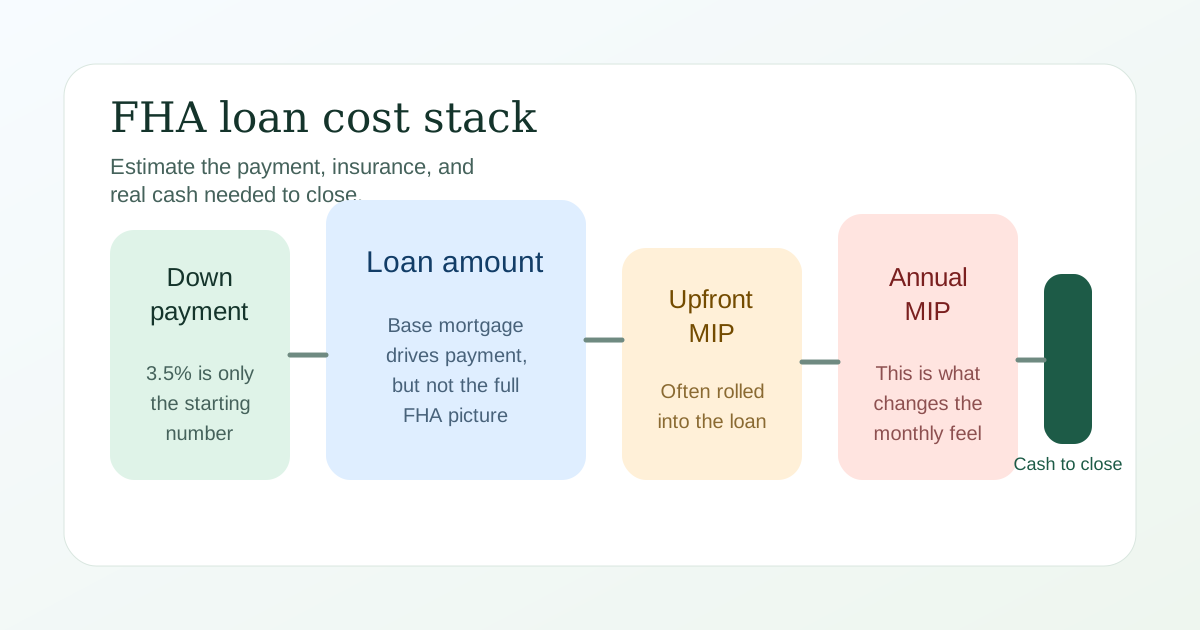
A useful FHA loan calculator should show the monthly payment, upfront mortgage insurance premium, annual mortgage insurance, and a realistic cash-to-close estimate.
Without those pieces, buyers often underestimate both the monthly payment and the amount of cash they need before the keys are handed over.
What people are obviously searching for
These are the direct, high-intent queries behind the page:
- FHA loan calculator
- FHA mortgage calculator
- FHA payment calculator
- FHA mortgage insurance calculator
- FHA MIP calculator
- FHA loan payment calculator
- FHA monthly payment calculator
- FHA down payment calculator
- FHA affordability calculator
- FHA cash to close calculator
What buyers are really asking underneath those keywords
The long-tail questions reveal the real friction points:
- How much house can I buy with 3.5% down and FHA mortgage insurance?
- Is FHA still worth it when rates are above 6%?
- How much does FHA MIP add to the monthly payment?
- Can FHA be cheaper than conventional if my credit score is not great?
- How much cash do I really need beyond the down payment?
- Do seller credits actually make FHA easier to close?
- What happens if the home price is above my county's FHA limit?
- Should I use FHA now and refinance later?
- When does FHA mortgage insurance go away?
- How do I compare FHA versus 5% down conventional without guessing?
Why FHA intent is strong right now
Rates are still high enough that down-payment flexibility matters
On July 3, 2026, the Associated Press reported Freddie Mac's average 30-year fixed rate at 6.43%, the lowest in seven weeks but still far above the ultra-low-rate period buyers remember. That rate backdrop pushes more shoppers toward payment models where down payment flexibility matters as much as rate shopping.
FHA can be competitive when the borrower is cash-constrained
The CFPB's mortgage comparison tool says FHA and VA scenarios can offer lower rates than conventional options, and it specifically notes that FHA can be less expensive for borrowers with lower credit scores and down payments below roughly 10% to 15%. That does not automatically make FHA cheaper overall, because mortgage insurance still has to be counted, but it explains why the search intent stays commercial and urgent.
Local limits turn a generic mortgage search into a county-level decision
HUD's CY2026 FHA mortgage limits page makes the practical point most buyers miss: FHA limits vary by area. A buyer can have a sound monthly payment estimate and still be targeting a purchase price that falls outside the local FHA range.
How to estimate an FHA payment with Calcsy
1. Start with the target home price and minimum down payment
Use the Mortgage Calculator to estimate the base payment from home price, down payment, rate, and term. For FHA shoppers, that starting down payment is often 3.5%, but the monthly result is only the beginning.
2. Add mortgage insurance instead of pretending it is minor
HUD-backed FHA loans typically include both upfront and ongoing mortgage insurance. If your calculator ignores MIP, you are comparing an incomplete payment to a complete rent number, which makes the result misleading.
3. Compare FHA against the nearest conventional alternative
The PMI Calculator Guide helps compare the payment effect of low-down-payment conventional financing. The right comparison is not FHA in isolation. It is FHA versus the best conventional option you could realistically qualify for today.
4. Keep cash to close separate from down payment
Buyers often say they have the down payment and only later discover that prepaid taxes, insurance, title charges, and lender fees change the required cash number. The Closing Costs Calculator Guide is the right companion here.
The cost layers an FHA calculator needs to capture
Base loan amount
This is driven by the purchase price minus down payment. It is the figure most calculators show first, and the one buyers tend to focus on too early.
Upfront mortgage insurance premium
FHA financing usually includes an upfront mortgage insurance premium that many buyers roll into the loan. That choice can soften cash strain at closing, but it increases the financed balance.
Annual mortgage insurance
This is what buyers feel every month. If the headline payment looked affordable before MIP and tight after MIP, the tighter number is the one that matters.
Taxes, homeowners insurance, and HOA dues
These are not unique to FHA, but first-time buyers often miss how quickly they lift the full housing payment. If you are evaluating affordability, use the all-in number, not just principal and interest.
Common FHA decision scenarios
First-time buyer with limited savings
This is the classic FHA case. The buyer is trying to enter the market with less cash down and may be willing to carry mortgage insurance in exchange for getting into the home sooner.
Buyer with workable income but imperfect credit
Some shoppers are not short on income, but their credit profile makes conventional pricing unattractive. For them, FHA can be a payment bridge rather than a forever loan.
Buyer planning to refinance later
Some borrowers are explicitly using FHA as a now solution, expecting to refinance if credit improves or market rates fall. That plan can work, but only if today's payment is safe without assuming a rescue refinance.
Where buyers make the biggest mistakes
Using the mortgage calculator without adding FHA insurance
This is the most common error. It makes the payment look cleaner than it will actually be.
Confusing minimum down payment with sufficient cash to close
A buyer can meet the minimum down payment and still come up short on total funds needed to close.
Ignoring the county loan limit until late in the process
HUD's FHA limit tool exists because local caps matter. A dream-home number is not useful if the structure of the program does not fit the target property.
Assuming FHA is automatically the cheaper choice
Sometimes it is. Sometimes it is just the more accessible choice. The difference matters, and only a side-by-side payment comparison answers it.
How Calcsy fits the FHA comparison workflow
Calcsy is most useful when you treat it as a comparison engine, not a one-number answer. Start with the base mortgage estimate, then pressure-test the result with the Down Payment Calculator Guide, the PMI Calculator Guide, and the How Much House Can I Afford Calculator Guide. That sequence gives you a cleaner answer to the question buyers usually mean: not "Can I get approved?" but "What version of this purchase stays comfortable after the first month of excitement wears off?"
Related calculators and guides
- Mortgage Calculator for the base principal-and-interest estimate.
- PMI Calculator Guide for low-down-payment conventional comparisons.
- Closing Costs Calculator Guide for a more realistic cash-to-close target.
- Down Payment Calculator Guide for comparing 3.5%, 10%, and 20% down paths.
- How Much House Can I Afford Calculator Guide for turning payment comfort into a price ceiling.
FAQ
What should an FHA loan calculator include?
It should include the home price, down payment, rate, term, mortgage insurance, and an estimate of cash to close.
Why do people use FHA instead of conventional financing?
Because FHA can work well for buyers who need a smaller down payment or who price out better in FHA than conventional due to credit or cash constraints.
Do FHA loan limits matter?
Yes. Loan limits vary by county, so your purchase target has to fit both your budget and the program limit.
Is FHA always cheaper than conventional?
No. It can be more accessible, but the true answer depends on rate, credit, down payment, PMI or MIP, and closing cash.
What is the most common FHA budgeting mistake?
Using only principal and interest, then realizing too late that mortgage insurance and closing costs materially change the decision.