USDA Loan Calculator Guide: Payment, Rural Eligibility, Income Limits, and Zero-Down Mortgage Math
As of July 10, 2026, USDA loan calculator intent is still high because buyers want the rare combination of no down payment and conventional-looking monthly mortgage math. The search is not just "what is the payment." People are trying to answer whether a specific address qualifies, whether total household income breaks the rules, whether seller credits can preserve cash, and whether USDA still beats FHA or a small-down-payment conventional loan once taxes, insurance, and fees are counted honestly.
Model the mortgage payment while you read.
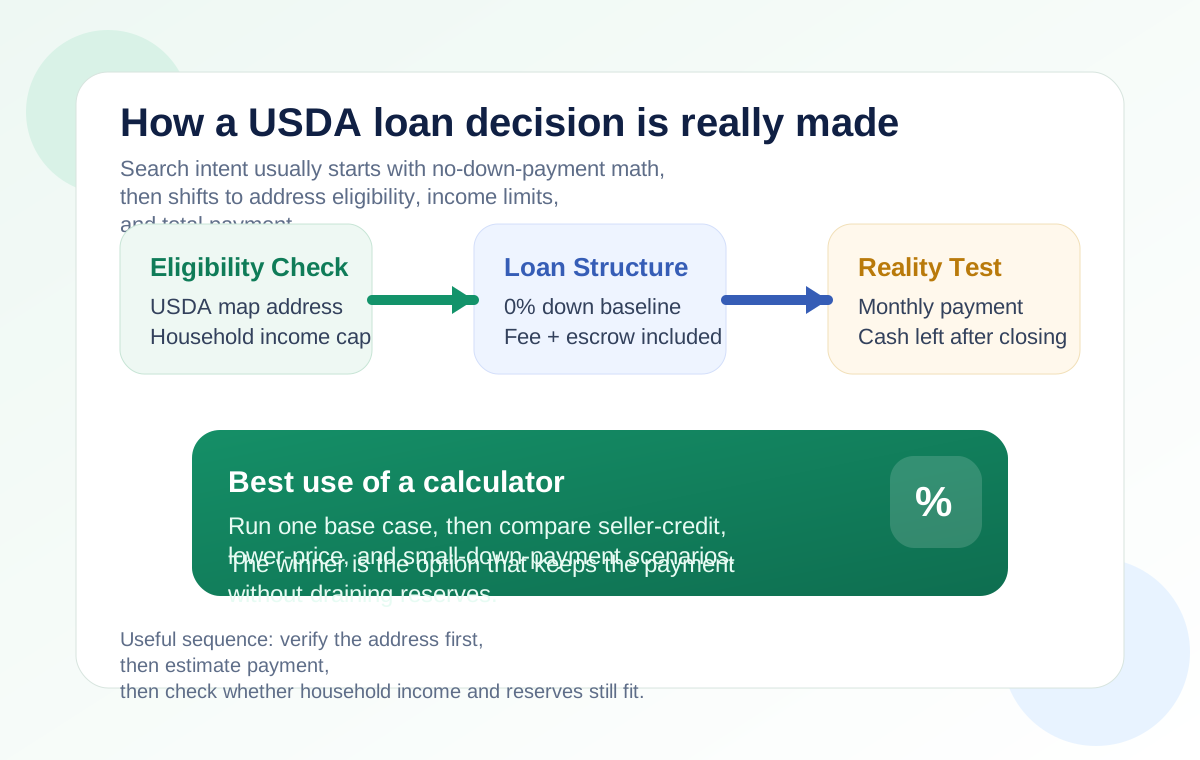
Open the Mortgage CalculatorQuick answer: what a USDA loan calculator should show
A useful USDA loan calculator should estimate the real monthly housing payment after principal, interest, taxes, insurance, and program-specific fee assumptions.
It should also help you test the broader decision: whether the property is actually USDA-eligible, whether your household income fits the program, and whether zero down is still the best tradeoff after closing costs and reserves.
What people are obviously searching for
- USDA loan calculator
- USDA mortgage calculator
- USDA rural development loan calculator
- USDA monthly payment calculator
- USDA home loan calculator
- USDA zero down mortgage calculator
- USDA loan eligibility calculator
- USDA direct loan calculator
- USDA guaranteed loan calculator
- USDA construction loan calculator
What people are really asking behind those searches
- Is this address rural enough to qualify even if it feels suburban?
- Does household income include a spouse or adult relative who is not on the loan?
- Is USDA still worth it if I can put 3% or 5% down another way?
- Can seller credits cover enough closing cost to keep emergency savings intact?
- How much higher does the payment get when taxes and insurance are added back in?
- Should I look at the guaranteed program or the direct program first?
- Can I use USDA for a manufactured or modular home?
- How do I estimate a USDA single-close construction payment before I talk to a lender?
- What if my income is close to the limit but my debts are low?
- Is the no-down-payment feature actually safer than using cash reserves for down payment?
Why this query has current search intent
Zero-down financing still stands out in a high-payment market
USDA remains one of the few mainstream paths where qualified borrowers can buy with 100% financing. That keeps search intent commercial and immediate because shoppers are comparing monthly affordability against limited savings, not just reading program trivia.
Buyers are checking map eligibility before they fall in love with a property
The USDA guaranteed program still requires the home to be in an eligible rural area. Search intent has shifted from generic rural-loan education to address-level qualification and payment realism.
Current USDA rules make the direct-versus-guaranteed distinction matter
The official USDA direct-loan page shows that, effective July 1, 2026, the current interest rate for Single Family Housing Direct home loans is 5.250%, with payment assistance that can reduce the effective rate as low as 1% for qualified low-income borrowers. That makes many searchers ask a more precise question: am I shopping the right USDA lane before I compare lenders?
What the official program pages say
Guaranteed loans
The USDA Single Family Housing Guaranteed Loan Program says eligible applicants may purchase, build, rehabilitate, improve, or relocate a dwelling in an eligible rural area with 100% financing, and that guaranteed-program income cannot exceed 115% of median household income. That is why a calculator alone is not enough. The payment may work while the address or income rules do not.
Direct loans
The USDA direct-loan page shows a separate path for low- and very-low-income borrowers, with payment assistance based on adjusted family income and a fixed published rate that updates over time. Searchers often mix this up with the guaranteed program even though the underwriting path and borrower profile are different.
Single-close construction-to-permanent loans
USDA's combination construction-to-permanent fact sheet adds another current branch of intent. It says the single-close product allows approved lenders to close a new construction loan and receive a loan note guarantee before construction begins, with fixed interest rates set at closing and options for interest-only construction payments or full PITI during the build.
How to estimate a USDA payment with Calcsy
1. Start with the full purchase price, not the amount you wish the home cost
Use Calcsy's Mortgage Calculator with the real contract price or your maximum target price. Zero down can make a house feel more affordable than it is because the financed balance stays high.
2. Add taxes and insurance before judging the payment
Many USDA searches are really escrow searches. Pair this guide with the Mortgage Calculator With Taxes and Insurance Guide and the Property Tax Calculator Guide so you do not stop at principal and interest.
3. Run a reserves check, not just a qualification check
USDA's appeal is low cash at closing, but a buyer with no reserves can still become house-poor. Test whether you can keep cash for moving, repairs, and ordinary emergencies instead of maxing out the purchase only because zero down is available.
4. Compare USDA against a small-down-payment alternative
Run a second scenario where you put 3% to 5% down or buy at a slightly lower price. Sometimes the winning move is not "use zero down forever." It is "use the cheapest path that still leaves breathing room."
The three filters that usually eliminate bad USDA assumptions
Address eligibility
The USDA eligibility map is not a formality. Searchers often discover that a town they assumed was rural is not eligible, while an outer-ring suburb or smaller community sometimes is.
Household income, not just borrower income
Search intent around income limits is more nuanced than many calculators admit. Guaranteed-program eligibility is tied to household income, so shoppers often need to know whether other earners in the home affect the limit.
Total payment comfort
A USDA approval possibility does not answer the practical question. The practical question is whether the payment still feels safe after taxes, insurance, utilities, maintenance, and commuting tradeoffs.
Where USDA compares well and where it does not
Where USDA is attractive
USDA tends to win when a buyer has stable income, limited savings for down payment, an eligible address, and a property price that keeps the monthly payment comfortably inside budget.
Where another path can beat it
If the home is ineligible, household income is above the cap, or the payment is too tight even at zero down, the better move may be FHA, conventional low-down-payment financing, or a lower purchase target.
Common mistakes to avoid
Assuming zero down means low monthly cost
Zero down protects upfront cash, but it also means a larger financed balance and often a payment that is more sensitive to taxes and insurance.
Using list-price optimism instead of escrow reality
People often search USDA math because they are trying to stretch into homeownership. That is exactly when optimistic assumptions become dangerous.
Confusing direct and guaranteed USDA programs
The borrower profile, application path, and current rate context are not the same. If you are near the lower-income end, the direct-loan page may matter more than the lender marketing pages you see first.
Ignoring construction-use cases
For some rural buyers, the real search is not an existing-home payment at all. It is whether a single-close USDA construction option can fund land, building costs, and permanent financing in one structure.
Related calculators and guides
- Mortgage Calculator for core monthly payment estimates.
- Mortgage Calculator With Taxes and Insurance Guide for full PITI budgeting.
- Property Tax Calculator Guide for monthly escrow realism.
- Closing Costs Calculator Guide for cash-to-close planning.
- FHA Loan Calculator Guide for side-by-side low-down-payment comparisons.
FAQ
What should a USDA loan calculator include?
It should estimate principal and interest, taxes, insurance, relevant USDA fee assumptions, and the total monthly payment after zero-down financing.
Does USDA mean any house in the countryside qualifies?
No. USDA eligibility depends on the exact address and program rules, so the property should be checked on the USDA eligibility site before you rely on the estimate.
Does household income matter even if only one person is on the loan?
Yes, that is one of the most important search-intent questions because guaranteed-program eligibility is tied to household income limits, not just the named borrower.
Can USDA be used for building a home?
Yes, in some cases. USDA's combination construction-to-permanent option allows approved lenders to offer a single-close path for eligible new construction in qualifying rural areas.
Why compare USDA with FHA if USDA has no down payment?
Because a no-down-payment product can still lose if the address is ineligible, the income cap is exceeded, or the payment after escrow items is too tight.