Hourly to Salary and Take-Home Pay Guide
Convert hourly pay into annual salary, monthly income, weekly pay, and a realistic take-home estimate before you accept an offer or build a budget.
Want to run your own numbers while reading?
Open the Salary CalculatorQuick answer: hourly to salary formula
Annual gross salary = hourly rate x hours per week x weeks per year.
For a standard full-time schedule, many people use 40 hours per week and 52 weeks per year. That equals 2,080 work hours per year.
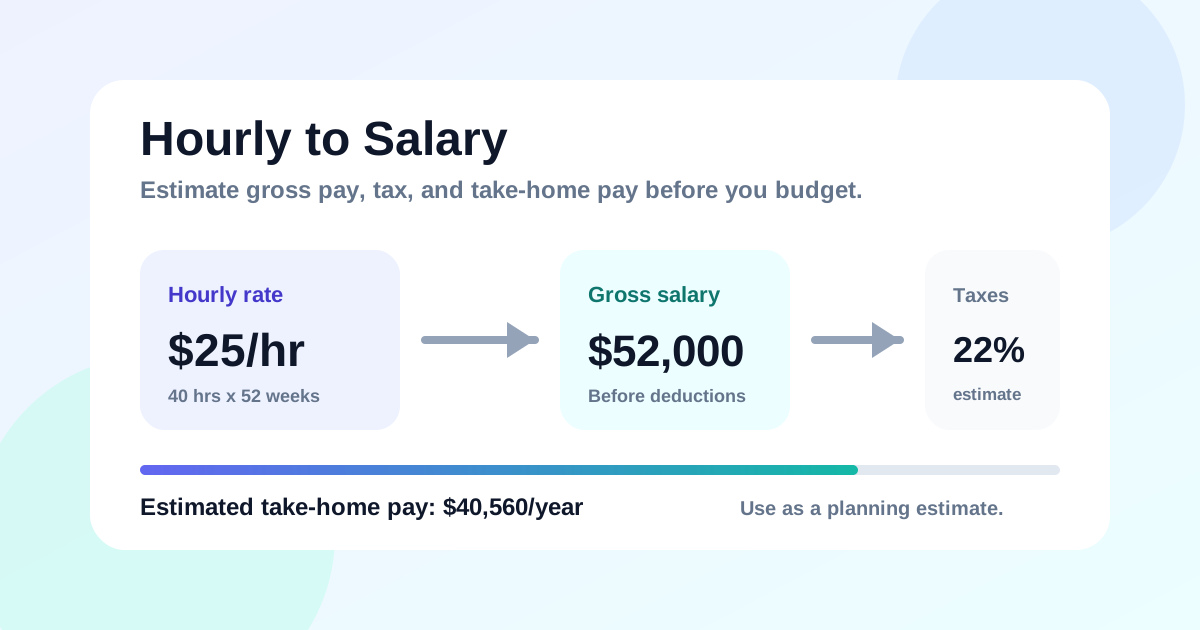
Example: if you earn $25 per hour and work 40 hours per week for 52 weeks, the calculation is:
$25 x 40 x 52 = $52,000 per year before taxes.
Common questions people ask before converting hourly pay
Research from salary calculator searches, job forums, and common pay questions shows that people are usually not just asking for a formula. They are trying to understand whether a job offer, raise, promotion, or schedule change is actually better in real life.
1. How much is my hourly wage per year?
Multiply your hourly wage by your weekly hours and annual working weeks. If your hours change each week, calculate a low, normal, and high scenario instead of trusting one number.
2. How much is my hourly wage per month?
For a simple estimate, divide annual gross salary by 12. A $52,000 annual salary is about $4,333 per month before taxes. Actual paycheck timing can be different if you are paid weekly, biweekly, semi-monthly, or monthly.
3. Why is take-home pay lower than salary?
Gross salary is pay before deductions. Take-home pay is what remains after income tax withholding, payroll taxes, benefits, retirement contributions, and other deductions. The IRS recommends checking withholding after major life changes because withholding affects take-home pay and possible tax bills.
4. Should I use 52 weeks or fewer weeks?
Use 52 weeks if you are paid for the full year. Use fewer weeks if you have unpaid time off, seasonal work, unpaid holidays, school-year work, contract gaps, or planned breaks. For example, $25 x 40 x 50 equals $50,000 instead of $52,000.
5. Does overtime change the annual salary number?
Yes. If you are eligible for overtime, overtime can change your annual gross pay a lot. In the United States, the Department of Labor explains that covered nonexempt employees generally receive overtime pay of at least 1.5 times the regular rate after 40 hours in a workweek. Rules vary by country, state, province, job type, and exemption status.
Hourly to salary examples
- $15/hour: $15 x 40 x 52 = $31,200 per year before taxes.
- $20/hour: $20 x 40 x 52 = $41,600 per year before taxes.
- $25/hour: $25 x 40 x 52 = $52,000 per year before taxes.
- $30/hour: $30 x 40 x 52 = $62,400 per year before taxes.
- $40/hour: $40 x 40 x 52 = $83,200 per year before taxes.
How to estimate take-home pay
A simple take-home estimate starts with a tax percentage. Calcsy's salary calculator lets you enter an estimated tax rate so you can compare gross salary with estimated annual and monthly take-home pay.
Example using $52,000 gross salary and a 22% estimated tax rate:
- Estimated tax: $52,000 x 22% = $11,440
- Estimated annual take-home pay: $52,000 - $11,440 = $40,560
- Estimated monthly take-home pay: $40,560 / 12 = $3,380
This is only a planning estimate. Real paycheck amounts can change because of filing status, tax credits, local taxes, retirement contributions, health insurance, union dues, bonuses, commissions, and payroll timing.
Salary vs hourly: what should you compare?
When people move from hourly to salary, the mistake is comparing only the headline number. A fair comparison should include:
- Expected hours per week, including unpaid overtime.
- Paid time off, holidays, sick time, and unpaid weeks.
- Health insurance, retirement match, bonuses, and other benefits.
- Commute cost, schedule flexibility, and job stability.
- Whether overtime pay is available or whether the role is exempt.
If a salary offer looks higher but requires many more hours, your effective hourly rate may be lower than expected. If an hourly job has overtime and strong benefits, it may beat a salary offer that looks better at first glance.
Direct salary calculator questions answered
These are the basic questions people ask when they already know they need a wage or salary calculator:
- How does an hourly to salary calculator work?
- What should I enter into a salary calculator?
- How do I convert hourly wage to annual salary?
- What is hourly pay as a yearly salary?
- How is take-home pay different from gross pay?
- How do I estimate monthly salary from hourly pay?
- How do I estimate weekly pay from hourly pay?
- What is my annual salary before taxes?
- How do I compare gross pay to net pay?
- How do I estimate salary after tax?
Deeper job-offer questions answered
These questions usually come from people comparing job offers, promotions, taxes, or real budgeting decisions:
- How much is $25 an hour after taxes monthly?
- Is salary better than hourly if overtime is common?
- How do I convert hourly pay to salary with unpaid time off?
- What salary equals $30 an hour?
- How do I compare an hourly job to a salary offer?
- Why is my take-home pay less than my salary?
- Why does the 40 hours x 52 weeks formula matter?
- How do salaried employees estimate their effective hourly rate?
- How can I estimate annual income with a tax rate?
- How do I estimate monthly take-home pay from hourly wage?
Common mistakes to avoid
Using gross pay as your budget
Gross pay is not the amount you can spend. Always estimate take-home pay before planning rent, savings, debt payments, or a major purchase.
Ignoring unpaid time off
If you are hourly and do not get paid vacation, using 52 weeks may overstate your annual income. Try 50 or 48 weeks to see a more conservative estimate.
Forgetting overtime or extra hours
A salary job that regularly requires 50 or 60 hours per week can reduce your effective hourly rate. An hourly job with overtime may produce more gross pay than a salary offer with the same base equivalent.
Comparing jobs without benefits
Benefits can change the real value of a job. Health insurance, retirement match, paid leave, remote work, commute savings, and predictable scheduling all matter.
FAQ
What is $25 an hour annually?
At 40 hours per week and 52 weeks per year, $25 an hour is $52,000 per year before taxes.
What is $20 an hour annually?
At 40 hours per week and 52 weeks per year, $20 an hour is $41,600 per year before taxes.
How do I calculate monthly pay from hourly pay?
First calculate annual gross salary using hourly rate x weekly hours x weeks per year. Then divide by 12 for estimated monthly gross pay.
How do I estimate take-home pay from hourly pay?
Estimate annual gross salary first, then subtract estimated taxes and deductions. A simple tax-rate estimate can help with planning, but official payroll calculators are better for final decisions.
Is hourly or salary better?
Neither is automatically better. Hourly pay can include overtime, while salary may offer predictable pay and benefits. Compare total compensation, expected hours, benefits, and take-home pay.
Useful related calculators
After estimating salary, you may also want to check how income affects debt, savings, and purchases:
- Salary Calculator for hourly, weekly, monthly, annual, and take-home estimates.
- Loan Payment Calculator to compare monthly debt payments against income.
- Compound Interest Guide to estimate how savings could grow over time.
Research references
This guide was shaped around common question patterns from salary calculator searches and job discussion topics, then checked against official payroll and labor resources: