Compound Interest Calculator Guide: Monthly Contributions, APY, and Growth Over Time
Current search intent around compound interest is practical, not academic. The SEC's Investor.gov calculator asks for an initial investment, monthly contribution, years, estimated rate, and compounding frequency, while NerdWallet's current guide pushes people to test different contribution amounts and frequencies. Searchers want to know how much their money can grow, how fast it can double, and whether small monthly deposits actually matter.
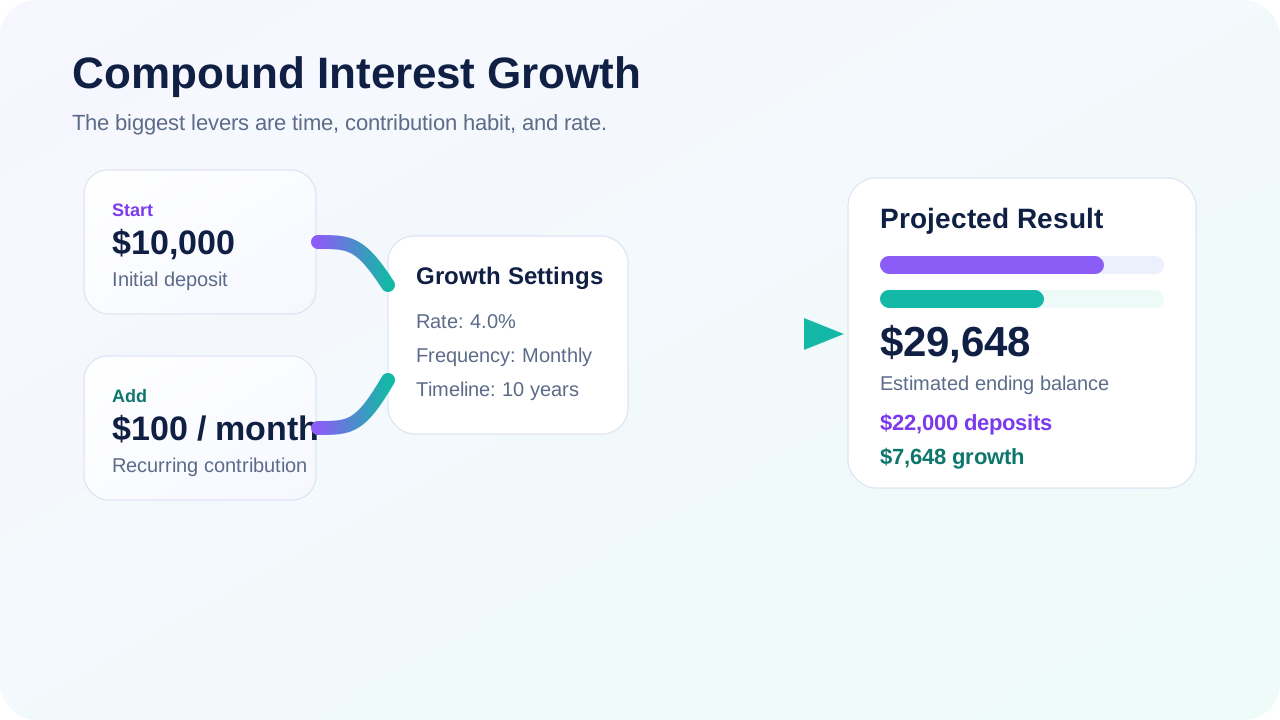
Run a few scenarios side by side before you commit to a savings target.
Open the Compound Interest CalculatorWhat people search for directly
These head-term searches show clear calculator intent and strong monetization value around savings, banking, and investing:
- compound interest calculator
- interest calculator
- savings growth calculator
- compound savings calculator
- investment growth calculator
- APY calculator
- daily compound interest calculator
- monthly compound interest calculator
- how long will money take to double
- compound interest formula
What people are actually trying to figure out
Long-tail queries usually reveal the real planning task hiding behind the broad keyword:
- How much will $10,000 grow in 10 years at 4%?
- How much difference does adding $100 a month make?
- Should I use APY or annual interest rate in a calculator?
- Does daily compounding matter more than monthly compounding?
- How long will it take my money to double at 6%?
- Is compound interest better in a savings account or a CD?
- What if I contribute at the end of each month instead of the beginning?
- How do I estimate retirement growth without assuming too much?
- Why does my savings account result differ from my brokerage estimate?
- Can I use the same calculator for withdrawals as well as deposits?
Why this search intent matters
Search results for this topic are still dominated by calculator pages, not opinion pieces. Investor.gov frames the task as determining how money can grow from an initial investment, monthly contributions, rate, and compounding schedule. NerdWallet's June 1, 2026 calculator explainer emphasizes testing years, return, compound frequency, and contribution frequency to see how different habits change the result. That means the winning page should help people model outcomes, not just define a term.
Core formula and the inputs that change the outcome
Future value without contributions = principal x (1 + rate / periods)periods x years
Future value with recurring deposits = growth on the principal plus growth on each contribution over time
The formula matters, but in practice four inputs drive most decisions:
- starting balance
- monthly contribution amount
- estimated annual return
- time horizon
Compounding frequency matters too, but usually less than contribution size and time. Investopedia's current overview makes the same point in a different way: more compounding periods can increase the result, but the larger force is staying invested long enough for interest to build on interest.
Example: why recurring contributions change the picture
NerdWallet's current example uses a $10,000 starting balance at 4% compounded daily. With no extra deposits, the account grows far more slowly than the version with an extra $100 added each month. The lesson is simple: people often obsess over compounding frequency when the bigger lever is regular saving.
Quick takeaway: a better savings habit usually beats tiny optimizations in frequency. If you can only improve one variable, improve the contribution amount or the timeline first.
How to use a compound interest calculator well
Start with a realistic rate
Do not plug in an aggressive rate just because the output looks better. For cash savings, compare against high-yield savings or CDs. For long-term investing, test a range rather than one perfect number.
Run low, middle, and high scenarios
Investor.gov includes an interest-rate variance range for a reason. One estimate is not enough when the future return is uncertain. A range makes the output more useful for planning.
Model contributions explicitly
Monthly contributions are not a minor detail. They are often the difference between a nice result and a meaningful result. If your income is uneven, test a few different contribution levels rather than forcing one fixed forecast.
Keep APY and annual rate straight
NerdWallet notes that many banks advertise APY, while calculators may ask for annual interest rate before compounding. If the calculator expects one and you enter the other without adjusting, your estimate can drift.
When to use related calculators instead
Rule of 72 for fast mental math
If you only want a rough doubling-time estimate, the Rule of 72 is faster than a full calculator. Investopedia's current explanation still uses 72 divided by the annual return to estimate how long doubling may take.
CD or savings comparisons
If you are comparing bank products rather than long-run investing, use tools focused on APY and maturity instead of pretending every savings goal behaves like a market account.
Retirement planning
If your real question is whether you are on track for retirement, a simple compound interest estimate is a start, but it should be paired with income needs, inflation assumptions, and withdrawal planning.
Common mistakes people make
Overweighting frequency
Daily compounding sounds powerful, but time and contribution habits usually dominate the final result.
Ignoring contribution timing
Contributing every month instead of waiting until year-end can materially change long-term growth.
Using one perfect return number
A single optimistic rate can make a plan look better than reality. Scenario ranges are safer.
Forgetting inflation
A future balance can look large while buying less than expected. Growth planning is better when you separate nominal growth from real purchasing power.
Related calculators and guides
- Compound Interest Calculator for quick scenario testing.
- Rule of 72 Guide for fast doubling-time estimates.
- Invest $100 a Month Compound Interest Guide for recurring-deposit planning.
- CD Calculator Guide if your comparison is cash savings rather than investing.
- Personal Loan Calculator Guide if you need to compare borrowing costs against savings goals.
FAQ
How do I calculate compound interest with monthly contributions?
Start with an initial amount, then add a recurring monthly contribution and an estimated annual return over a set number of years. A calculator handles the repeated compounding and contribution growth automatically.
Does compound frequency matter much?
It matters, but usually less than time, contribution size, and overall return. More frequent compounding helps, but steady saving and a longer horizon usually matter more.
What is the Rule of 72?
It is a shortcut for estimating doubling time. Divide 72 by the annual return to get an approximate number of years.
Should I use APY or interest rate?
Use the input the calculator asks for. Some tools want annual rate before compounding, while many banks advertise APY after compounding.
Can a compound interest calculator be used for withdrawals?
Yes, if the tool supports negative monthly contributions or withdrawal modeling. Investor.gov's calculator explicitly allows that use case.