Home Equity Loan vs Cash-Out Refinance Calculator Guide: Payment, Legacy Rate, Fees, and Total Cost
As of July 17, 2026, home-equity comparison intent is highly commercial because homeowners are still navigating two very different borrowing realities. Freddie Mac said on July 16, 2026 that the average 30-year fixed mortgage rate was 6.55%, while WSJ Buy Side put average home-equity-loan rates at 8.12% on July 17, 2026. That does not make cash-out refinance the automatic winner. Many homeowners are still sitting on much older first mortgages with rates far below today's market, so replacing the whole loan can be more expensive than adding a second fixed loan. Searchers want a calculator that exposes that tradeoff clearly.
Model the replacement mortgage while you read.
Open the Mortgage CalculatorQuick answer: what this calculator comparison should show
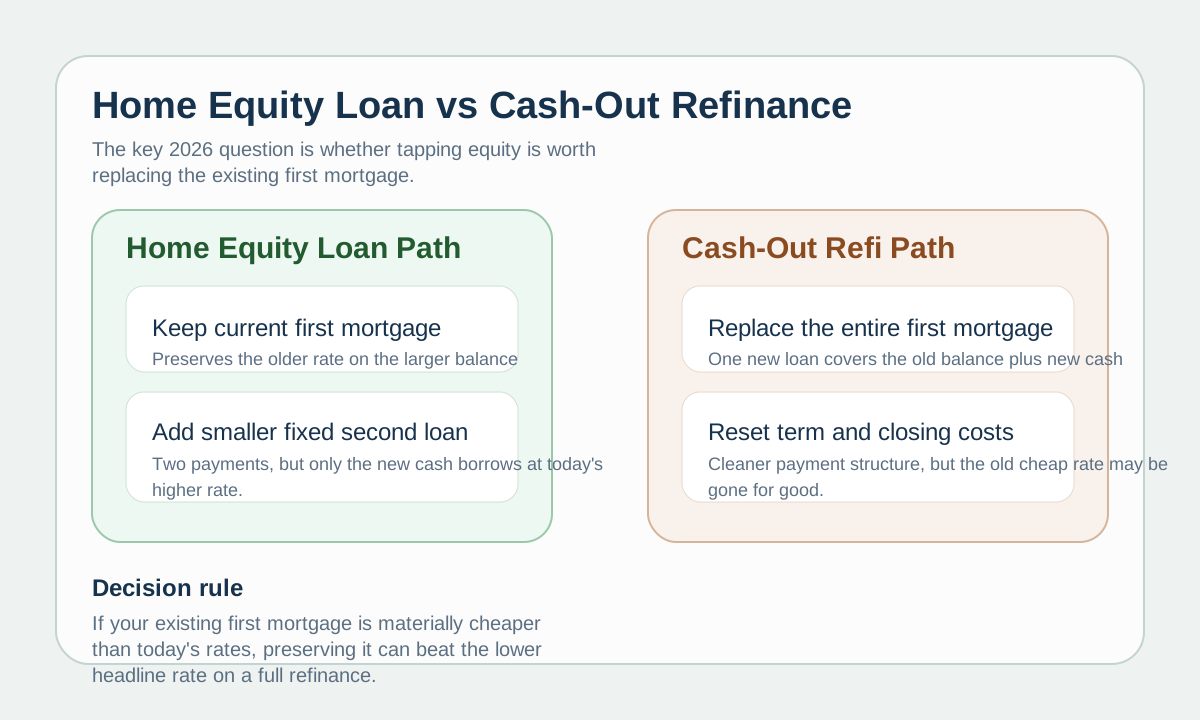
A useful home equity loan versus cash-out refinance calculator should compare the current mortgage payment, the new combined payment under the second-loan option, the replacement payment under cash-out refinance, the fees, and the total interest impact of giving up the old first mortgage.
If it ignores the old mortgage rate, it misses the main reason this choice is hard in 2026.
What people are obviously searching for
The direct keyword set is commercial and comparison-heavy:
- home equity loan vs cash-out refinance calculator
- cash-out refinance vs home equity loan calculator
- second mortgage vs cash-out refinance
- home equity loan payment calculator
- cash-out refi payment calculator
- should I use a home equity loan or refinance
- best way to tap home equity
- cash-out refinance for debt consolidation
- home equity loan for renovation calculator
- keep low mortgage rate or cash-out refinance
What homeowners are really asking before they borrow
The long-tail questions expose the real decision pressure:
- Should I replace a 3% mortgage just to pull out $50,000?
- How much more interest will I pay if I reset my whole mortgage term?
- Is a home equity loan smarter if I only need a one-time lump sum?
- How much cash do refinance closing costs eat before I even start the project?
- What if I plan to move in a few years and do not want a full reset?
- Will two payments still be cheaper than one bigger new mortgage?
- Is a cash-out refinance better if my current mortgage rate is already high?
- Can I use home equity for debt consolidation without making my housing risk worse?
- Which option gives me more predictable payments in a high-rate market?
- What is the cleaner choice if my current loan balance is already fairly low?
Why this comparison is active right now
Mortgage rates stayed elevated into mid-July 2026
Freddie Mac reported on July 16, 2026 that the average 30-year fixed mortgage rate rose to 6.55%. That is high enough that many borrowers hesitate to touch an older low-rate first mortgage at all.
Home-equity loans are also expensive, but the structure can still win
WSJ Buy Side's July 17, 2026 update put average home-equity-loan rates at 8.12%. On headline rate alone, that looks worse than cash-out refinance. In practice, a second loan can still be cheaper overall when it leaves a much cheaper existing first mortgage untouched.
Searchers are choosing between efficiency and preservation
U.S. Bank's comparison calculator frames the same core issue borrowers keep raising in forums and lender tools: compare the full monthly result and cash available, not just the quoted rate on the new money.
How to compare home equity loan versus cash-out refinance with Calcsy
1. Start with the current mortgage baseline
Write down the remaining balance, current rate, remaining term, and payment. Without that baseline, a cash-out refinance quote can look cleaner than it really is.
2. Model the cash-out refinance as a full replacement loan
Use Calcsy's Mortgage Calculator for the new total loan amount, new rate, and new term. This shows what happens when the entire first mortgage is replaced.
3. Model the second-loan case separately
Use the Loan Payment Calculator for the home-equity-loan amount, rate, and term, then add that payment to your current first mortgage. That is the combined-payment comparison many people skip.
4. Put fees and housing budget back into the decision
Cash-out refinance often carries meaningfully larger closing costs than a second loan. Pair this guide with the Closing Costs Calculator Guide and Mortgage Calculator With Taxes and Insurance Guide so the new debt is judged inside the full monthly housing stack.
When a home equity loan usually fits better
You want to protect an old low-rate mortgage
This is the most common 2026 reason. The second loan may carry a higher rate, but only on the smaller borrowed amount, while the larger first balance keeps its cheaper pricing.
You need a one-time lump sum, not a full mortgage rewrite
If the project is defined and the amount is fixed, a fixed-rate second loan can be simpler than replacing the whole first mortgage.
You may move before refinance costs pay back
Shorter hold periods often make preserving flexibility and limiting upfront cost more important than building a brand-new 30-year mortgage.
When a cash-out refinance usually fits better
You want one payment instead of two
Some borrowers value simplicity more than preserving the old mortgage. One loan can be easier to manage and easier to explain inside the household budget.
Your current first mortgage is not especially cheap
If the old rate is already near current market levels, the penalty for replacement may be modest enough that cash-out refinance deserves a serious look.
You need a larger amount and better first-lien pricing on all of it
In some cases a larger borrowing need makes the second-loan structure feel awkward or too expensive monthly, especially if the borrower wants a long fixed term.
Mistakes that distort the comparison
Comparing only the new-money rate
The borrowed cash is not the whole story. The existing mortgage being preserved or replaced is often the bigger cost lever.
Ignoring total interest after a term reset
A lower-looking payment under a fresh 30-year refinance can hide a much longer interest tail.
Skipping closing costs
Cash-out refinance fees can materially reduce the usable cash and change the break-even window.
Using home-secured debt to solve a recurring budget problem
Either option can relieve short-term pressure while raising long-term housing risk if the underlying spending problem stays intact.
Related calculators and guides
- Mortgage Calculator for the full replacement-loan payment under cash-out refinance.
- Loan Payment Calculator for the fixed second-loan payment under a home equity loan.
- Cash-Out Refinance Calculator Guide for the full first-lien replacement case.
- Home Equity Loan Calculator Guide for the fixed second-mortgage case by itself.
- Refinance Calculator Guide for break-even framing once you add fees and timeline assumptions.
FAQ
What should a home equity loan vs cash-out refinance calculator show?
It should compare the current mortgage, the combined payment under a second loan, the replacement payment under a cash-out refinance, and the fees and total-cost differences between them.
When is a home equity loan usually better than a cash-out refinance?
Usually when you want to preserve a meaningfully cheaper existing mortgage and only need a fixed lump sum.
When is a cash-out refinance usually better than a home equity loan?
Usually when you want one loan instead of two, need more cash, and are not giving up a much cheaper first mortgage.
What is the biggest comparison mistake?
Forgetting that the old first mortgage is part of the math, not just background context.
Can the second-loan option still win with a higher rate?
Yes. If the older first mortgage rate is much lower than today's market, preserving it can outweigh the higher rate on the smaller second loan.