Debt Payoff Calculator Guide: Snowball vs Avalanche Planning
People searching for a debt payoff calculator usually want more than one number. They want to know how long debt will take to clear, whether extra payments really matter, and which payoff order makes the most sense when several balances compete for the same monthly budget.
Test a fixed-payment scenario while you read.
Open the Loan Payment CalculatorQuick answer: what a debt payoff calculator should show
A useful debt payoff calculator should show payoff time, monthly payment, total interest, and how extra payments change the result.
For one installment loan, that math is straightforward. For multiple debts, the result depends on balance order, APR differences, minimum payments, and whether you follow a snowball or avalanche strategy.
What people are obviously searching for
Current debt-planning question is direct and problem-solving. Common calculator questions include:
- debt payoff calculator
- debt repayment calculator
- credit card payoff calculator
- debt snowball calculator
- debt avalanche calculator
- how long to pay off debt calculator
- loan payoff calculator
- extra payment calculator debt
- pay off debt faster calculator
- debt reduction calculator
What people are really asking before they act
The practical questions usually sound more personal and more urgent:
- Should I pay the smallest debt first or the highest APR first?
- How much faster will I be debt-free if I add $100 a month?
- Which debt should get extra payments when all of them feel expensive?
- Can I use a loan payoff calculator for credit card debt?
- How do minimum payments slow everything down?
- Is debt consolidation cheaper than paying each balance separately?
- Should I keep an emergency fund while paying off debt?
- What if one debt has the highest APR but another has the smallest balance?
- How do I compare payoff speed against total interest paid?
- What monthly payment fits my income after bills and savings?
How to use a debt payoff calculator the right way
1. Separate single-loan math from multi-debt planning
If you are paying one personal loan, fixed car loan, or other installment debt, the math is clean: amount owed, APR, term, and monthly payment. That is exactly where Calcsy’s Loan Payment Calculator is strongest.
If you are juggling several balances, the calculator becomes a planning tool instead of a single exact answer. You need to decide which balance gets the extra payment first and whether the strategy is driven by motivation or by interest savings.
2. Know the tradeoff between snowball and avalanche
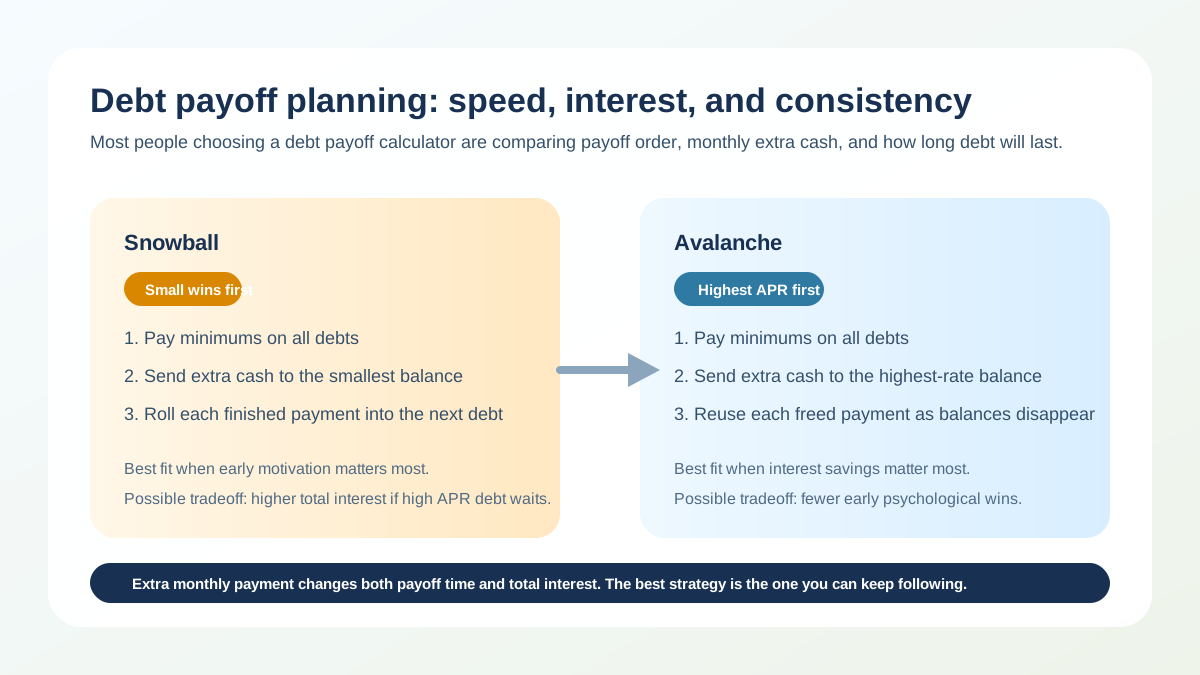
The debt snowball method pays the smallest balance first for momentum. The debt avalanche method targets the highest APR first to reduce total interest. planning question around both is strong because people are not just curious about the formula. They are trying to choose the payoff method they can actually follow next month.
In general, avalanche is more efficient mathematically, while snowball may be easier behaviorally. That behavioral point matters because an optimal spreadsheet plan is still weak if you abandon it after two billing cycles.
3. Test the extra-payment threshold
Many searchers do not need a complex strategy change. They need to know whether adding $50, $100, or $200 monthly makes enough difference to justify the sacrifice. On higher-rate debt, small recurring extra payments can cut both payoff time and total interest more than people expect.
4. Use realistic monthly cash flow
A debt payoff plan only works if it survives groceries, rent, car insurance, and irregular expenses. Use your actual after-tax income, not your optimistic best month. Calcsy’s Salary Calculator can help you estimate gross versus net pay before you commit to an extra payment target.
Example: why strategy order matters
Imagine three debts:
- Credit card: small balance, very high APR
- Personal loan: medium balance, mid-range APR
- Auto loan: larger balance, lower APR
If the credit card is both the smallest and highest-rate balance, snowball and avalanche point to the same first move. If the smallest balance is not the highest-rate balance, the strategies diverge. That is exactly why searchers compare debt snowball calculator and debt avalanche calculator side by side. They are trying to see whether motivation or interest savings matters more in their situation.
Can you use a loan payment calculator for debt payoff?
Yes, with limits. It works best for installment loans where the interest rate and term are fixed. For revolving credit cards, the true result can shift because rates may compound differently, minimum payments change as balances fall, and some issuers apply payments in ways that are less intuitive than borrowers expect.
Use a loan calculator as a clean estimate for one balance at a time, then compare scenarios. For example, run a personal loan at the current APR, then rerun it with a larger monthly payment to see how much faster payoff happens.
Common mistakes to avoid
Only looking at the monthly payment
A lower monthly payment can hide a longer payoff path and more total interest. Time matters almost as much as payment size.
Ignoring the highest APR debt for too long
Snowball can work, but delaying an expensive balance indefinitely can keep interest costs elevated. If motivation is the reason for choosing snowball, build in a review point after the first payoff win.
Using gross income instead of spendable income
If the extra payment depends on overtime, bonuses, or an unrealistically lean budget, the plan may fail quickly.
Skipping the consolidation comparison
If a consolidation offer lowers APR meaningfully without loading in costly fees, it can change the best path. This is where understanding APR and total borrowing cost becomes important.
Related calculators and guides
- Loan Payment Calculator for fixed-rate installment payoff estimates.
- Salary Calculator to estimate what monthly payment fits your income.
- Loan Payment Calculator Guide for the core monthly-payment formula.
- APR Calculator Guide to compare borrowing costs beyond the interest rate headline.
- Car Loan Calculator Guide if one of your major debts is auto financing.
FAQ
Is snowball or avalanche better for paying off debt?
Avalanche usually saves more interest because it targets the highest APR first. Snowball may be easier to maintain because it creates earlier payoff wins.
How much faster can extra monthly payments reduce debt?
Often much faster than expected, especially on higher-rate debt. Even modest recurring overpayments can shorten payoff time and reduce total interest materially.
Can a loan payment calculator work as a debt payoff calculator?
Yes for one fixed-rate installment loan. It is less exact for credit cards and multi-debt strategies because those require changing minimum payments, compounding assumptions, and payoff order decisions.
Should I build savings before paying debt aggressively?
Many borrowers keep at least a small emergency buffer so a surprise expense does not go straight back onto a card. The right split depends on your cash-flow stability and current rates.
What matters more: payoff speed or total interest?
Both matter. If you need motivation, speed can keep you consistent. If your rates are high, interest savings become more important quickly.