Debt Consolidation Loan Calculator Guide: Compare APR, Fees, and Monthly Payment
Debt consolidation loan searches in June 2026 are highly practical. People are not just looking for a lower payment. They are trying to find out whether rolling credit cards and other balances into one fixed personal loan will actually reduce interest, whether origination fees erase the benefit, how bad-credit pricing changes the math, and whether a simple monthly payment will finally make payoff stick. With many advertised personal-loan rates still in the double digits, planning question is cautious and comparison-heavy.
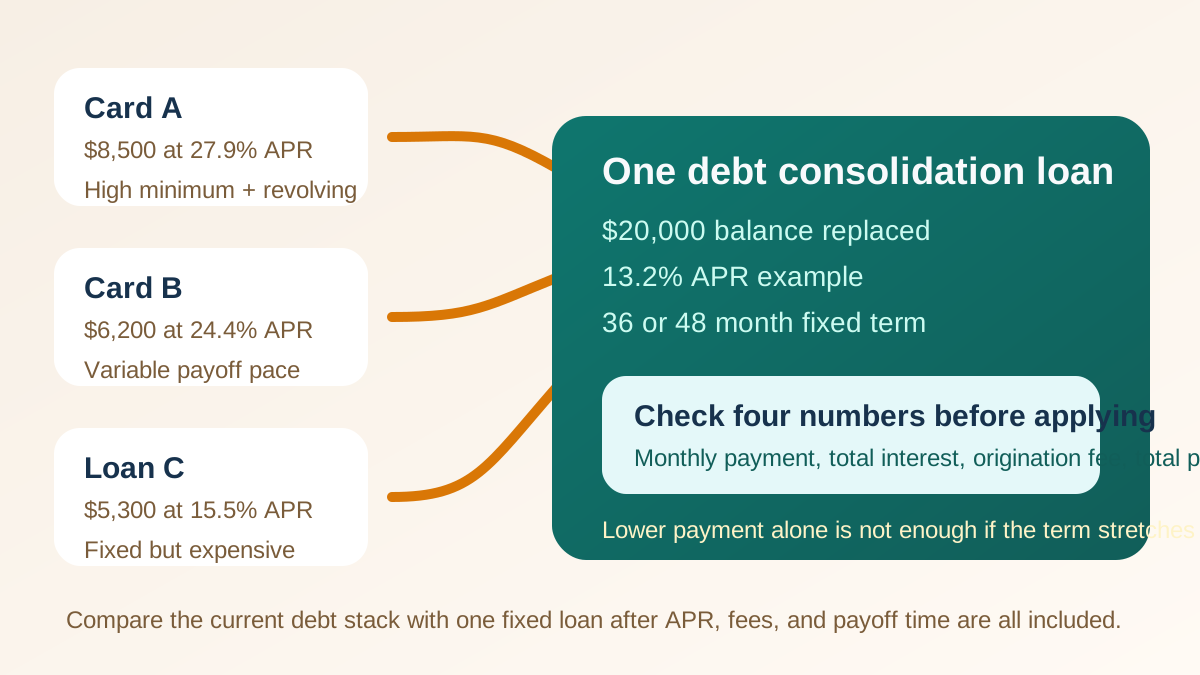
Model the replacement loan payment while you read.
Open the Loan Payment CalculatorQuick answer: what a debt consolidation loan calculator should do
A useful debt consolidation loan calculator should estimate the new monthly payment, total interest, total cost, and the savings or loss compared with keeping your current debts.
It should also force one uncomfortable but important question: are you lowering cost, or only stretching debt over a longer term so the payment looks easier?
What people are obviously searching for
The direct keyword cluster is commercial and close to action:
- debt consolidation loan calculator
- debt consolidation calculator
- credit card consolidation loan calculator
- personal loan debt consolidation calculator
- monthly payment debt consolidation calculator
- debt refinance calculator
- consolidate debt loan calculator
- best debt consolidation loan rates
- debt consolidation loan with bad credit
- loan vs balance transfer calculator
What people are really asking before they apply
The long-tail questions are more revealing and more useful:
- Will a debt consolidation loan actually save me money after fees?
- What credit score do I need for a decent consolidation rate?
- Is one fixed payment better than card minimum payments?
- Should I consolidate credit cards and a personal loan together?
- How much would a $20,000 debt consolidation loan payment be?
- Does a longer term lower stress or just add more interest?
- Is balance transfer better if I can pay debt off fast?
- Will consolidating debt hurt or help my credit score?
- Can I qualify with fair or bad credit and still save money?
- Should I use a home equity loan instead of an unsecured loan?
Why current debt consolidation intent is so cautious
Rates are not low enough to save everyone automatically
WSJ Buy Side's June 15, 2026 debt consolidation roundup said the average APR for a three-year personal loan was 13.21% as of June 8, 2026, based on Credible partner data. That is good enough to beat many credit cards, but not good enough to guarantee savings for every borrower once fees and term length are included.
Borrowers want predictability, not just relief
Current searchers often want one fixed due date, one payoff schedule, and one number they can budget around. That is why debt consolidation intent overlaps so heavily with payment calculators, payoff planners, and take-home pay questions.
Bad-credit questions are part of the main query now
Recent June 2026 lender guides spend substantial space on bad-credit qualification because many searchers already know the ideal outcome depends on the rate they can actually get, not the rate shown in an ad.
How to use Calcsy for debt consolidation math
1. Add up the debt you would really replace
Start with the balances you plan to eliminate with the new loan, not every debt you have ever touched. This keeps the scenario focused and lets you compare a realistic payoff path instead of a vague wish list.
2. Run the proposed loan as a fixed installment payment
Use Calcsy's Loan Payment Calculator with the amount, APR, and term you are considering. If you are comparing two lenders, rerun both options with the same loan amount and different APRs or terms. For broader borrowing-cost context, the APR Calculator Guide explains why rate and APR can diverge.
3. Adjust for origination fees and net proceeds
If the lender charges an origination fee, the effective borrowing cost is worse than the headline payment may suggest. Some borrowers need to borrow slightly more so the net amount after fees still covers the balances they are trying to pay off.
4. Compare the new payment with actual monthly cash flow
A fixed loan payment can be easier to follow than revolving minimums, but it is less forgiving if your budget is already tight. Calcsy's Salary Calculator and Paycheck Calculator Guide help translate income into a payment number you can defend.
Questions real borrowers ask before consolidating
Will the new payment really be lower?
Often yes, but not always for a good reason. A lower payment can come from a lower APR, a longer term, or both. Only the first one clearly improves efficiency. The second one may simply trade urgency for comfort.
What if I can get a lower monthly payment but pay more overall?
That is one of the most common traps. Many borrowers search for debt consolidation help because cash flow is strained, so the smaller payment feels like the answer. It may still be the right choice, but only if you understand the tradeoff.
Is a balance transfer better than a consolidation loan?
For borrowers who can clear the debt during a low-rate promotional window, maybe. For borrowers who need structure and a fixed finish line, a consolidation loan can be easier to manage month after month.
Should I use home equity to consolidate unsecured debt?
This can reduce the rate, but it changes unsecured debt into debt backed by your home. That is why this search often overlaps with the caution in the Home Equity Loan Calculator Guide.
Common consolidation scenarios
High-interest credit card balances
This is the classic case. If the new personal-loan APR is materially below the card APRs and the fee load is manageable, consolidation may simplify repayment and reduce interest.
Mixed debt with uneven rates
Sometimes one card is punishingly expensive while another balance is tolerable. In that case the best move may be partial consolidation, not a full reset of every account.
Borrowers who need structure more than optimization
A debt plan that is slightly less efficient but actually followed can beat a mathematically perfect plan that fails after two months. That is where fixed-payment clarity matters.
Mistakes to avoid
Only comparing monthly payment
You need the full comparison: monthly payment, total interest, fees, and total paid.
Ignoring fees deducted from proceeds
If a lender withholds an origination fee, the amount arriving to your creditors may be smaller than the amount you thought you borrowed.
Keeping the old spending habit after paying off cards
This is the classic failure pattern. The old balances disappear, then the cards slowly fill again.
Using secured debt to solve an unsecured-debt habit
Secured consolidation can work, but the downside gets much more serious when a home becomes collateral.
Related calculators and guides
- Loan Payment Calculator for the fixed monthly payment, total paid, and total interest on a consolidation loan.
- Debt Payoff Calculator Guide if you are deciding between consolidation and a snowball or avalanche plan.
- APR Calculator Guide to compare headline rates with all-in borrowing cost.
- Salary Calculator for checking what payment fits your income rhythm.
- Home Equity Loan Calculator Guide if you are weighing unsecured consolidation against borrowing against your house.
FAQ
What should a debt consolidation loan calculator show?
It should show the new payment, total interest, total paid, and whether the loan improves the outcome after fees and term length are included.
Does debt consolidation always save money?
No. It only helps when the new APR, fees, and payoff term produce a better result than the debts you already have.
Is a debt consolidation loan better than a balance transfer?
It depends on the transfer fee, promotional period, and whether you need a fixed repayment schedule instead of a temporary teaser rate.
Can I consolidate debt with bad credit?
Possibly, but the rate may be high enough that the savings disappear. Qualification alone is not the real goal. Better terms are.
What is the biggest mistake people make?
They celebrate the lower payment without checking whether the total cost and behavior risk got better or worse.