Credit Card Payoff Calculator Guide: Estimate Payment, Interest, and Faster Debt Exit
As of June 29, 2026, credit card payoff planning question is urgent, not casual. People are trying to figure out how long a balance will really take, how much interest a 20% to 30% APR can add, whether a 0% balance transfer actually helps after the fee, and what monthly payment is big enough to create visible progress. People are also comparing payoff calculators against consolidation loans because card APRs remain stubbornly high even when rate headlines look calmer elsewhere.
Estimate a target monthly payment while you read.
Open the Loan Payment CalculatorQuick answer: what a credit card payoff calculator should show
A useful credit card payoff calculator should estimate payoff time, interest cost, and the monthly payment required to clear the balance by a target date.
It should also help you compare the current card against alternatives such as a balance transfer or consolidation loan, because many payoff decisions are really comparison decisions.
What people are obviously searching for
The direct intent cluster is high urgency and close to action:
- credit card payoff calculator
- credit card repayment calculator
- credit card interest payoff calculator
- minimum payment calculator credit card
- how long to pay off credit card debt
- credit card debt calculator
- balance transfer payoff calculator
- pay off credit card fast calculator
- monthly payment to pay off credit card
- credit card payoff schedule
What people are really asking before the next statement closes
Useful follow-up questions show the real problem behind the query:
- Why is my balance barely moving even though I pay every month?
- How much do I need to pay to get rid of this card in 12 months?
- Does paying twice a month help with credit card interest?
- Should I use a balance transfer or a debt consolidation loan?
- How much interest will a 24% APR card add if I take two years to pay it off?
- Is it smarter to pay the highest APR card first or the smallest balance first?
- Will a large one-time payment save more than slightly higher monthly payments?
- How do new purchases ruin a credit card payoff plan?
- What happens when the 0% balance transfer period ends before I finish?
- How do I build a payoff plan that survives variable income months?
Why this topic is hot right now
APR pressure is still the main pain point
Many people are dealing with APRs that still feel punishing. The Week reported on February 16, 2026 that average commercial credit card APRs were near 21%, while some real cardholder examples remain materially higher once promotional periods expire. That keeps payoff intent active even for people who are not adding new debt.
People want a finish line, not just a lower minimum
The query is increasingly about control. Searchers want to convert an open-ended revolving balance into a visible monthly plan, which is why payoff intent overlaps with debt snowball, debt avalanche, and consolidation-loan comparisons.
Balance-transfer questions are part of the same search now
Many users no longer search payoff math in isolation. They immediately ask whether a 0% transfer plus a 3% to 5% fee beats staying on the current card, and whether they can realistically clear the debt before the promotional window closes.
How to estimate a payoff plan with Calcsy
1. Freeze the balance for planning
A calculator becomes much more useful when you stop adding purchases to the card you are trying to eliminate. If spending continues, the payoff target keeps moving and the estimate loses value.
2. Set a realistic payoff deadline
Pick a date that matters to you, such as 12, 18, or 24 months. Then work backward into a payment target. Calcsy's Loan Payment Calculator can help approximate the fixed-payment discipline you are trying to create, even though revolving cards are messier than installment loans.
3. Match the payment to real income, not hope
Use the Paycheck Calculator Guide and Salary Calculator to see what your monthly cash flow can actually support. Payoff plans fail less often when the payment survives ordinary expenses, not just your most optimistic month.
4. Compare card payoff against consolidation alternatives
If a fixed-rate personal loan is available, compare it with the current card balance using the Debt Consolidation Loan Calculator Guide. Many People are not looking for the mathematically perfect answer. They are looking for the plan they will actually follow.
Minimum payment math is the trap most people are trying to escape
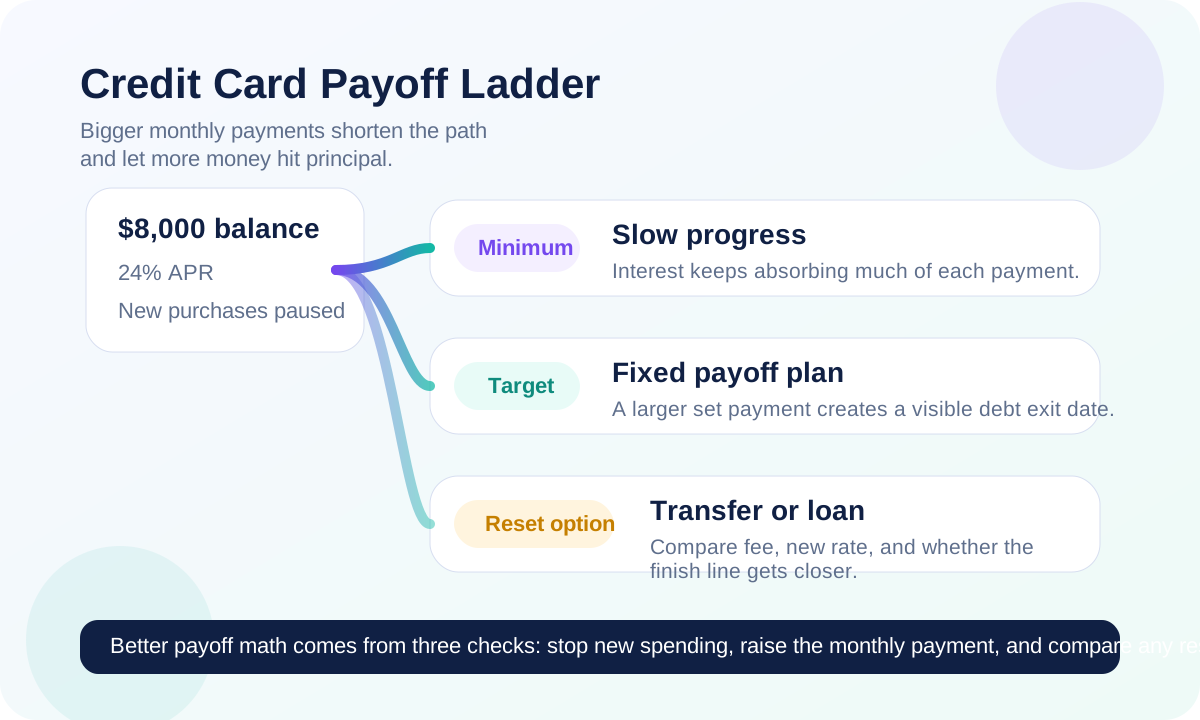
Minimum payments are designed to keep the account current, not to help you exit quickly. When interest absorbs a large share of each payment, the balance shrinks slowly and the required minimum may also drift downward. That is why credit card payoff intent is often emotionally charged: people feel like they are paying but not escaping.
Three payoff scenarios worth comparing
Higher fixed monthly payments
This is the cleanest path when cash flow allows it. The sooner the payment rises above the minimum, the more quickly interest stops dominating the schedule.
One-time lump sum plus normal payments
A tax refund, bonus, or side-income payment can create an outsized improvement because it cuts the balance before future interest keeps compounding on it.
Balance transfer or consolidation reset
A 0% transfer can be powerful if the fee is modest and the payoff window is realistic. A consolidation loan can be better if you need structure and a fixed end date rather than another revolving account.
How to think about avalanche versus snowball
Paying the highest APR card first usually saves the most interest. Paying the smallest balance first often creates faster emotional wins. The Debt Payoff Calculator Guide is useful when you are choosing between those two behavior models across multiple debts.
Common mistakes to avoid
Keeping the card active while trying to pay it off
If groceries, subscriptions, or occasional emergencies keep landing on the same balance, the payoff calculator becomes a moving target instead of a plan.
Comparing only the monthly payment
A smaller payment can feel safer while making the debt much more expensive over time.
Ignoring transfer fees and expiration dates
A 0% balance transfer is only good if the fee and the post-promo APR still produce a better outcome than your current card.
Assuming a credit card behaves exactly like a fixed loan
Credit cards can compound daily, minimums change, and new purchases can land at the worst possible time. Treat fixed-payment math as a planning estimate, not a perfect mirror.
Related calculators and guides
- Debt Payoff Calculator Guide for snowball versus avalanche strategy comparisons.
- Debt Consolidation Loan Calculator Guide for fixed-payment replacement options.
- Loan Payment Calculator for a target monthly-payment estimate when you want a fixed payoff schedule.
- APR Calculator Guide for comparing rate, fee, and total-cost differences.
- Paycheck Calculator Guide for translating income into a payoff amount you can sustain.
FAQ
What should a credit card payoff calculator show?
It should show an estimated payoff timeline, the monthly payment required, and the interest cost under that payment plan.
Why does paying only the minimum keep me in debt so long?
Because interest can consume a large part of each payment while the minimum itself often shrinks as the balance gets smaller.
Is a balance transfer always better than paying down the current card?
No. It only wins when the transfer fee, promo period, and your expected payment speed beat the cost of staying on the current APR.
Does paying twice a month help?
It can help some people stay disciplined and may reduce average daily balance slightly, but the bigger driver is still the total amount paid each month.
Should I use snowball or avalanche?
Avalanche usually saves more interest. Snowball can be easier to stick with if fast psychological wins matter more for your behavior.