Cash-Out Auto Refinance Calculator Guide: Check Payment, Equity, and Risk
Cash-out auto refinance intent in June 2026 is highly transactional and unusually cautious. People are not just trying to lower their car APR. They want to know whether they can tap vehicle equity for emergency cash, debt cleanup, or short-term breathing room without making the loan unaffordable or ending up underwater on a depreciating asset. That makes calculator intent more risk-assessment driven than standard car refinance traffic.
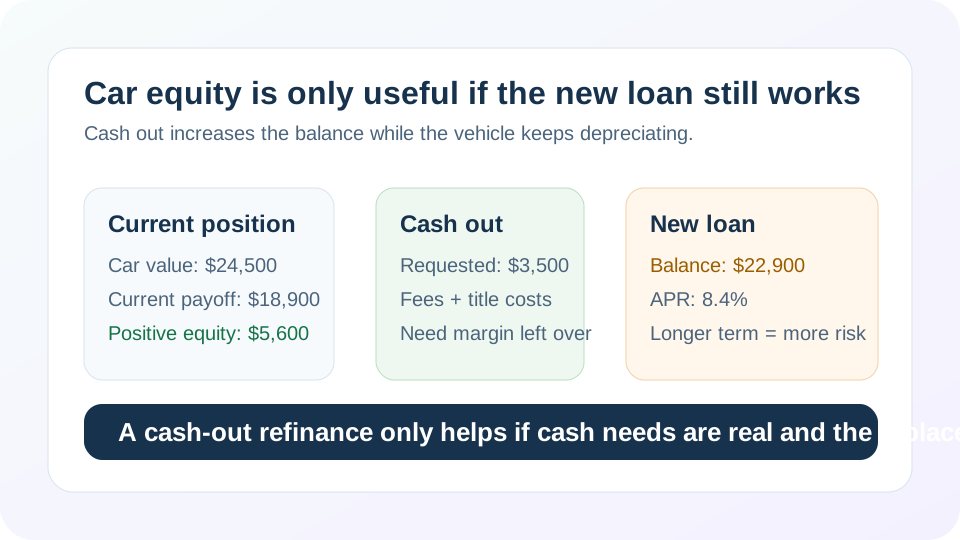
Test the replacement loan before you borrow against car equity.
Open the Car Loan CalculatorQuick answer: what a cash-out auto refinance calculator should do
A useful cash-out auto refinance calculator should estimate available equity, new loan size, monthly payment, total interest, and whether the cash-out amount is worth the added risk.
If it only shows how much cash you can pull out, it is not doing the important part. Vehicle equity is not free cash. It is debt moved onto an asset that keeps losing value.
What people are obviously searching for
The direct keyword cluster is commercial and close to action:
- cash-out auto refinance calculator
- cash out car refinance
- car equity loan calculator
- auto refinance calculator
- refinance car and take cash out
- how much cash can I get from auto refinance
- best cash-out auto refinance lenders
- car refinance monthly payment calculator
- refinance auto loan with positive equity
- cash-out refinance car loan requirements
What people are really asking before they do it
The hidden question set is more practical and more useful:
- How do I know whether my car has enough equity to refinance for cash?
- Will taking cash out put me upside down on the vehicle again?
- How much would my payment rise if I add $3,000 or $5,000 to the loan?
- Should I refinance my car for cash or use a personal loan instead?
- Can I cash out refinance if my credit score improved but my car is older?
- How long do I need to wait after buying a car before refinancing it?
- Is cash-out auto refinance smart for credit card payoff or just a trap?
- What if I need lower monthly payment and cash at the same time?
- Will refinancing hurt my credit score much?
- When do lender fees erase the benefit of the refinance?
Why current cash-out auto refinance intent is so cautious
Auto refinance rates are broad enough that comparison matters
WSJ Buy Side reported on June 22, 2026 that average auto refinance rates ranged from 4.67% to 13.43% as of June 8, 2026, based on RateGenius data. That spread is wide enough that borrowers cannot assume refinancing helps just because the product exists.
Cash-out adds risk on top of ordinary refinancing
WSJ Buy Side's June 1, 2026 cash-out auto refinance guide described typical rates in the 7% to 11% range and emphasized that the move creates more debt against the vehicle. That matters because the car keeps depreciating even while the new balance grows.
Many users are payment shoppers, not rate shoppers
Recent refinance coverage shows many borrowers want relief in the monthly budget more than they want a mathematically optimal loan. That is understandable, but it is exactly how a lower payment can hide a worse long-term outcome if the term is extended too far.
How to use Calcsy for cash-out auto refinance math
1. Estimate your current equity honestly
Start with an approximate real-world vehicle value and subtract the current payoff amount. If the equity is thin, the cash-out refinance may not be available or may not be worth the reset.
2. Model the larger replacement loan
Use Calcsy's Car Loan Calculator with the proposed new balance, APR, and term. Test at least two term lengths. The wrong term can make a seemingly manageable refinance much more expensive.
3. Compare the cash-out idea with non-vehicle alternatives
If the goal is emergency cash or debt cleanup, run the same amount through the Loan Payment Calculator to compare an unsecured option. If the cash is meant for high-interest debt, also compare the discipline and payoff tradeoffs in the Debt Consolidation Loan Calculator Guide.
4. Check timing and eligibility friction
WSJ Buy Side's April 13, 2026 refinance timing guide noted that title transfer can take 60 to 90 days and that waiting at least six months can improve qualification odds for some borrowers. So even strong calculator intent often includes a timing question, not just a payment question.
When a cash-out auto refinance is more defensible
You have clear positive equity and a stronger credit profile now
If your current loan was taken at a weak moment and your credit or debt-to-income ratio is better today, the refinance may improve pricing enough to justify the move.
You need a moderate amount of liquidity, not a rescue plan
Borrowers who need a few thousand dollars and can still support the new payment are in a different position from borrowers using car equity to postpone a larger financial crisis.
You still have enough loan life left for the refinance to matter
If you are near payoff, the remaining interest may be too small to justify resetting the loan. This is one of the most common reasons the math disappoints.
When it usually starts looking bad
The car is already close to negative equity
If the vehicle is only slightly ahead of the loan balance, cashing out can erase the safety margin almost immediately.
The refinance lowers payment mainly by stretching the term
This can feel like relief while quietly extending how long you owe on a depreciating asset.
The cash is going toward recurring budget gaps
If the money is for ongoing bills instead of a contained need, the refinance may solve this month without solving the underlying problem.
The vehicle is too old or outside lender rules
Eligibility limits on mileage, age, and remaining balance can kill the idea before the payment math matters.
Related calculators and guides
- Car Loan Calculator for testing the new loan amount, term, and payment.
- Car Loan Calculator Guide for the core auto-loan inputs that still matter after refinancing.
- Loan Payment Calculator for comparing an unsecured borrowing alternative.
- How Much Car Can I Afford? Car Loan Payment Guide for budget discipline if the current payment is already tight.
- Debt Consolidation Loan Calculator Guide if the real goal is reshaping high-interest debt rather than using the car as a cash source.
FAQ
What should a cash-out auto refinance calculator show?
It should show estimated equity, new loan size, payment, total interest, and the actual cost of extracting cash from the vehicle.
When does cash-out auto refinancing make sense?
Usually when you have positive equity, improved credit, and a contained cash need that still leaves the replacement payment affordable.
What is the biggest risk?
You can increase debt on a depreciating asset, end up with less equity protection, and raise the chance of repossession if your budget weakens.
How soon can I refinance a car after buying it?
Often not immediately. Title transfer commonly takes 60 to 90 days, and waiting longer can improve qualification with some lenders.
Will refinancing a car hurt my credit?
Usually only a little and temporarily, but the bigger issue is whether the new loan actually improves your position after fees, term length, and added balance.