Amortization Schedule Calculator Guide: Understand Every Monthly Payment
People searching for an amortization schedule calculator usually want more than one number. They want to know what the monthly payment will be, how much of that payment is interest, when the balance starts falling faster, and whether extra payments would save meaningful money.
Run the payment math while you read.
Open the Loan Payment Calculator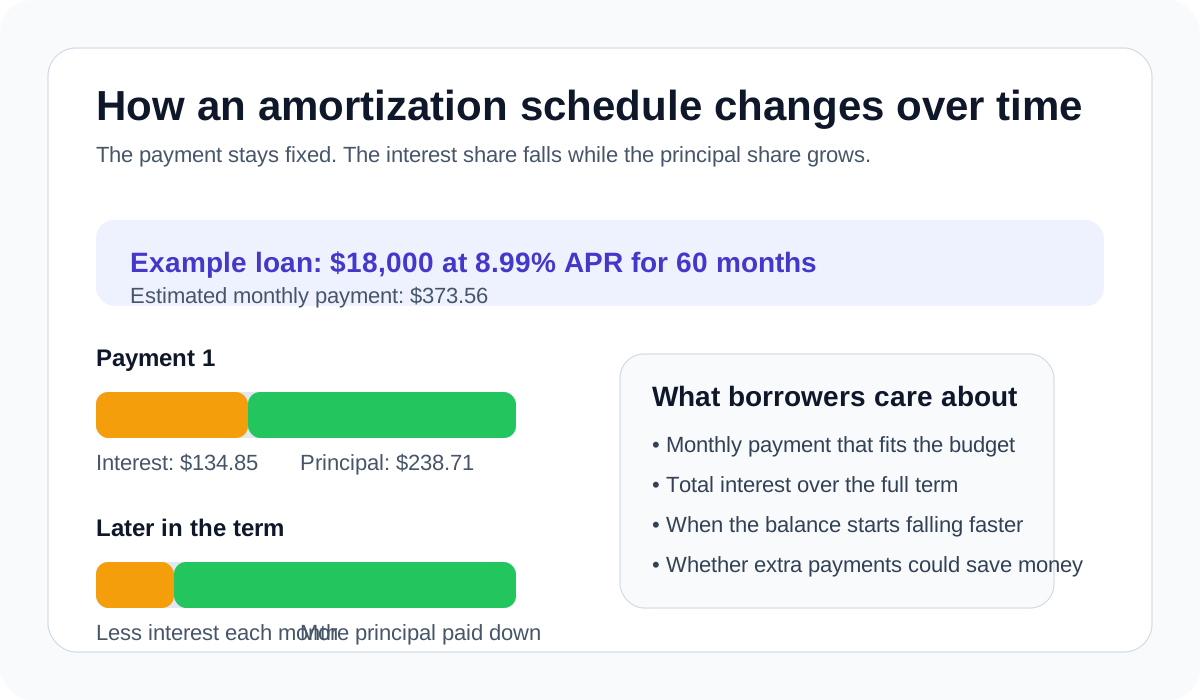
What people usually mean by "amortization schedule calculator"
Most people use this guide to understand a payment schedule, compare monthly payment options, see how principal and interest change over time, or estimate how extra principal could shorten a loan.
Useful follow-up questions behind those calculations are more practical: why does my first payment barely reduce the balance, how much interest will I pay over the whole loan, when do payments become mostly principal, can I compare a 36-month and 60-month term, what happens if I add extra principal, why does the lender total differ by a few cents, can I use this for a car loan or personal loan, what is the difference between APR and rate in the formula, why does a lower payment often cost more overall, and how do I know whether the payment fits my budget.
What an amortization schedule actually shows
An amortization schedule is a payment-by-payment table for an installment loan. Each row usually shows:
- The payment number or payment date.
- The fixed monthly payment amount.
- The interest charged for that period.
- The principal repaid in that payment.
- The remaining balance after the payment.
This is why amortization pages attract people with practical questions. The searcher is often borrowing soon, comparing lenders, or checking whether a loan really fits their monthly cash flow.
Basic amortization formula
monthly payment = principal x monthly rate / (1 - (1 + monthly rate)^-number of payments)
The formula uses the loan amount, the interest rate converted to a monthly rate, and the number of monthly payments. The payment may stay the same on a fixed-rate loan, but the split between interest and principal changes every month.
Example: $18,000 loan at 8.99% for 60 months
Using a fixed-rate installment loan with a 60-month term, the estimated monthly payment is $373.56. Over the full term, the total paid is about $22,413.78, including about $4,413.78 in interest.
First payment: about $134.85 interest and $238.71 principal.
Second payment: about $133.06 interest and $240.50 principal.
Third payment: about $131.26 interest and $242.30 principal.
That pattern answers one of the biggest user questions: the payment is fixed, but the interest charge gets smaller as the balance gets smaller. That is why the principal portion slowly rises over time.
Why the early payments feel interest-heavy
The balance is highest at the beginning
Interest is calculated from the remaining balance. At the start, the lender is charging interest on the largest balance you will owe during the term, so the interest line is largest in the early payments.
The payment is blended
Searchers often expect the payment to be split evenly between interest and principal. That is not how standard amortization works. The payment is blended so the loan can be fully paid off by the final month.
The turning point takes time
People looking up amortization schedule by month, payoff table, or principal vs interest chart usually want to know when the schedule starts working in their favor. It usually happens gradually rather than all at once.
How to compare two loan terms using the schedule
If you compare 36 months, 48 months, and 60 months, the longest term often produces the lowest monthly payment but the highest total interest. That is the core reason people search personal loan amortization or car loan payment breakdown before signing.
- Check the monthly payment first to see if it fits your budget.
- Check total interest second to see the real borrowing cost.
- Look at the early rows if you may sell, refinance, or repay early.
- Keep fees and optional add-ons separate from the pure loan math.
Questions real borrowers ask
Is an amortization schedule only for mortgages?
No. Searchers also use the same concept for personal loans, car loans, student loans, and many other fixed-payment installment loans.
Does the monthly payment ever change?
On a standard fixed-rate loan, the scheduled payment usually stays the same. Variable-rate loans, fees, insurance add-ons, or lender-specific structures can change that.
Can I save money with extra payments?
Usually yes, because extra principal can reduce future interest. People who search payoff calculator with extra payments or loan schedule with extra principal are usually trying to shorten the term or reduce total cost. Always confirm lender terms before assuming there is no prepayment restriction.
Why is my lender schedule a little different?
Small differences can come from rounding, payment timing, origination date conventions, optional fees, or how the lender posts payments inside its system.
Best internal tools and related guides
- Loan Payment Calculator for monthly payment, total paid, and total interest estimates.
- Car Loan Calculator if the loan also includes vehicle price, trade-in, or down payment decisions.
- Mortgage Calculator for home-loan scenarios and longer payoff horizons.
- Loan Payment Calculator Guide for the broad monthly payment formula.
- Car Loan Calculator Guide for auto-specific borrowing questions.
FAQ
What is an amortization schedule?
It is a table showing each loan payment and how that payment is split between interest, principal, and remaining balance.
Why do early payments go mostly to interest?
Because the loan balance is highest at the start, the interest charge is also highest at the start.
Can an amortization schedule help me choose a loan term?
Yes. It helps you compare monthly affordability against total interest cost instead of looking at payment alone.
Can I use this for a personal loan or auto loan?
Yes, as long as the loan is a standard fixed-payment installment loan. The same core logic applies.
Is this legal or financial advice?
No. This guide is educational and should be used as a planning reference, not as legal, financial, or lending advice.