Auto Refinance Calculator Guide: Lower APR, Lower Payment, Break-Even, and Negative Equity Checks
As of July 16, 2026, auto-refinance search intent is unusually practical. Borrowers are not browsing out of curiosity. They are trying to lower a payment that was locked in during a worse rate environment, or they are checking whether a credit-score improvement finally makes a refinance worth the paperwork. Recent reporting shows why this intent is active: WSJ reported in late June 2026 that Experian saw average refinance savings of about 2.24 percentage points and roughly $81 a month in Q1 2026, while lender roundups published in July still show refinance offers spreading widely by credit profile. Searchers want a calculator that answers the real question: does this new loan actually improve the situation after term length, fees, and equity limits are counted?
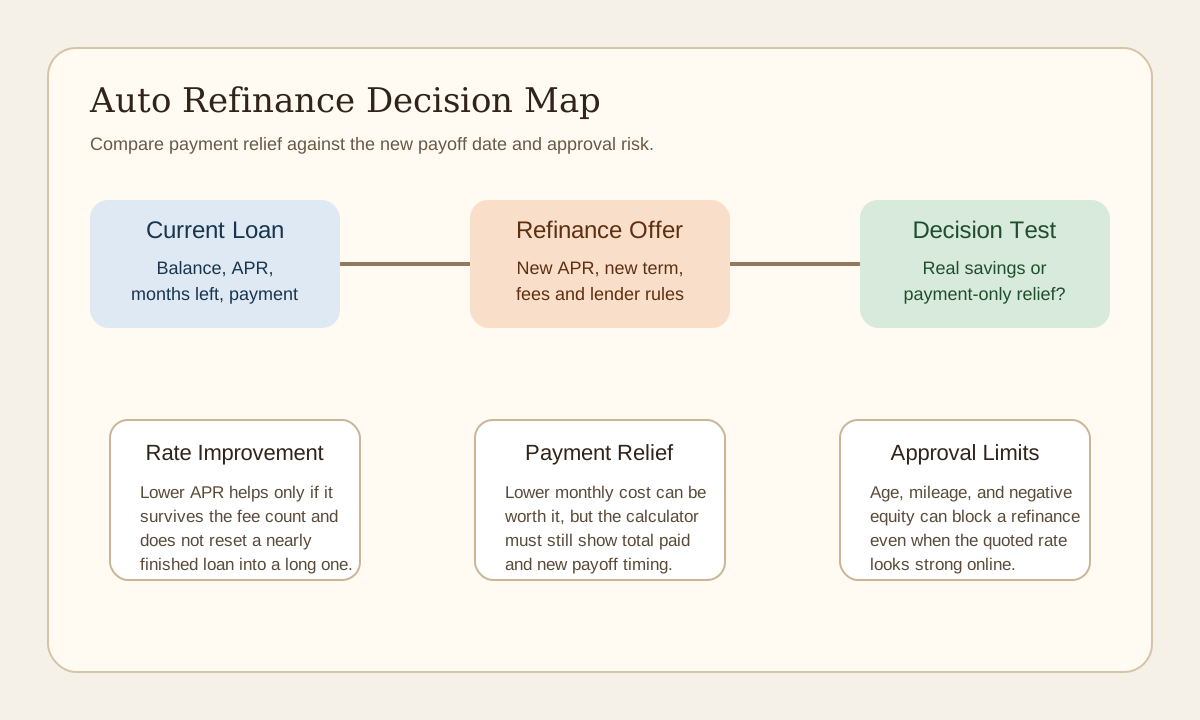
Compare the replacement loan math while you read.
Open the Car Loan CalculatorQuick answer: what an auto refinance calculator should show
A useful auto refinance calculator should show the old loan versus the new one side by side, including APR, monthly payment, remaining term, total interest, and whether the car's value still supports approval.
If it only shows a lower payment, it can hide the most important tradeoff: paying less each month because you restarted the clock.
What people are obviously searching for
The direct keyword set has strong lender-comparison and application intent:
- auto refinance calculator
- car loan refinance calculator
- refinance car payment calculator
- auto loan refinance calculator
- car refinance calculator
- lower car payment refinance calculator
- car refinance savings calculator
- auto refinance break even calculator
- refinance car loan with bad credit calculator
- can I refinance my car loan calculator
What borrowers are really asking before they apply
The long-tail questions reveal where the real decision pressure sits:
- Will refinancing my car actually save money or just lower the payment?
- How much does my rate need to drop before a refinance is worth it?
- Should I refinance if I only have two years left on the loan?
- Can I refinance a used car with high mileage?
- Will refinancing help if my credit score is much better now?
- Can I refinance if I owe more than the car is worth?
- How do lender fees change the savings math?
- Should I keep the same payoff date or stretch the term?
- Is refinancing smarter than making extra payments?
- What rate drop is realistic for fair-credit borrowers in 2026?
Why auto-refinance intent is strong right now
Borrowers who financed at peak stress are finally seeing savings
WSJ reported on June 24, 2026 that Experian found borrowers who refinanced in Q1 2026 cut their rate by an average of 2.24 percentage points, far better than the average improvement seen two years earlier. That kind of spread is large enough to make refinance math worth checking again.
Rate offers still vary sharply by credit tier
WSJ Buy Side's July 16, 2026 roundup put current refinance offers in a broad range, starting under 5% for stronger borrowers and moving into double digits for weaker profiles. That means many searchers are not asking whether refinancing exists. They are asking whether they personally moved into a better approval bucket.
Vehicle affordability pressure has not really eased
Associated Press, citing Edmunds on July 15, 2026, noted that new-vehicle prices are still close to $49,000 on average and warned buyers to watch negative equity closely. When cars remain expensive, refinancing the current loan becomes more attractive than replacing the vehicle.
How to estimate an auto refinance with Calcsy
1. Start with the exact current payoff, not an old balance screenshot
Your refinance lender cares about today's payoff amount. That number can differ from the last statement balance because of accrued interest and timing.
2. Rebuild the proposed refinance loan in Calcsy
Use the Car Loan Calculator with the refinance balance, quoted APR, and proposed term. Then compare it against your current payment structure, not against a guessed target.
3. Keep the payoff horizon visible
A refinance can look excellent monthly and still be weak overall if it resets a nearly finished loan into another long term. The Loan Payment Calculator Guide is useful here because it keeps total paid and total interest in view instead of letting the monthly number dominate the decision.
4. Check equity before treating approval as likely
If the car is underwater, the refinance question becomes partly an equity question. Pair this guide with the Negative Equity Car Loan Calculator Guide so the loan-to-value problem is not ignored.
The comparison points that matter most
APR improvement
This is the first number people focus on, and it matters. But the rate drop only becomes meaningful if the new term and fees do not neutralize it.
Monthly payment change
A lower payment can create breathing room, which is a real benefit. It just should not be confused with lower total cost by default.
Remaining term versus new term
If you had 28 months left and refinance into 60 months, you may have solved a cash-flow problem while creating a longer debt problem. That can still be the right move, but it should be explicit.
Vehicle age, mileage, and lender limits
Refinance approval is not only about your credit. Many lenders also screen for vehicle age, mileage, payoff size, and loan-to-value ratio.
Common refinance scenarios
Credit has improved since dealership financing
This is the cleanest refinance case. The borrower took a weak original rate, then improved their score or debt picture enough to qualify for meaningfully better pricing.
Payment relief matters more than lifetime interest
Some borrowers are not trying to optimize every dollar. They need the monthly payment lower now. That can be rational, but the calculator should still show what that relief costs over time.
The borrower wants to avoid rolling into another car
If replacement shopping would involve more taxes, fees, and possibly negative equity, refinancing the current vehicle can be the less damaging move.
Common mistakes to avoid
Comparing only the monthly payment
This is the most common mistake. Payment relief matters, but it is incomplete without total interest and new payoff date.
Refinancing a nearly finished loan into a fresh long term
The later you are in the current loan, the more carefully you need to test whether resetting the term still makes sense.
Ignoring fees and title-transfer costs
Some refinance offers look cleaner than they are because transfer fees or lender charges sit outside the headline rate comparison.
Applying before checking negative equity
If the car's value has fallen hard, approval may be constrained even when the rate quote looks attractive online.
Related calculators and guides
- Car Loan Calculator for comparing the old loan against the refinance offer.
- Negative Equity Car Loan Calculator Guide for underwater-loan and trade-in risk.
- Cash-Out Auto Refinance Calculator Guide if the lender is offering equity extraction instead of a simple rate reset.
- Car Sales Tax Calculator Guide if you are comparing refinancing the current car against replacing it.
- How Much Car Can I Afford Guide if the refinance question is really a broader affordability question.
FAQ
What should an auto refinance calculator show?
It should compare the current loan with the refinance offer side by side, including payment, APR, term, total interest, and any equity risk.
When does auto refinancing usually make sense?
Usually when your rate can drop meaningfully, your credit or lender options improved, and the new term does not erase the savings.
Can you refinance a car loan if you are underwater?
Sometimes, but the lender may cap approval based on the car's value, mileage, age, and total payoff balance.
How much rate improvement is enough?
There is no universal threshold, but the lower rate has to survive any fees and term reset once you compare the full loan cost.
Is refinancing better than making extra payments?
It depends. A lower rate can help immediately, while extra payments attack principal faster. The right answer depends on cash flow, approval odds, and how long you plan to keep the car.
Research references
- WSJ, June 24, 2026: Experian refinancing savings and payment relief
- WSJ Buy Side, July 16, 2026: current auto refinance rate ranges and lender landscape
- The Week, July 2026: when refinancing helps and when it backfires
- Associated Press, July 15, 2026: Edmunds guidance on rising car costs and negative equity risk